Lack of planning triggers severe traffic chaos at Baidyanath Sq
| Date :27-Oct-2025 |
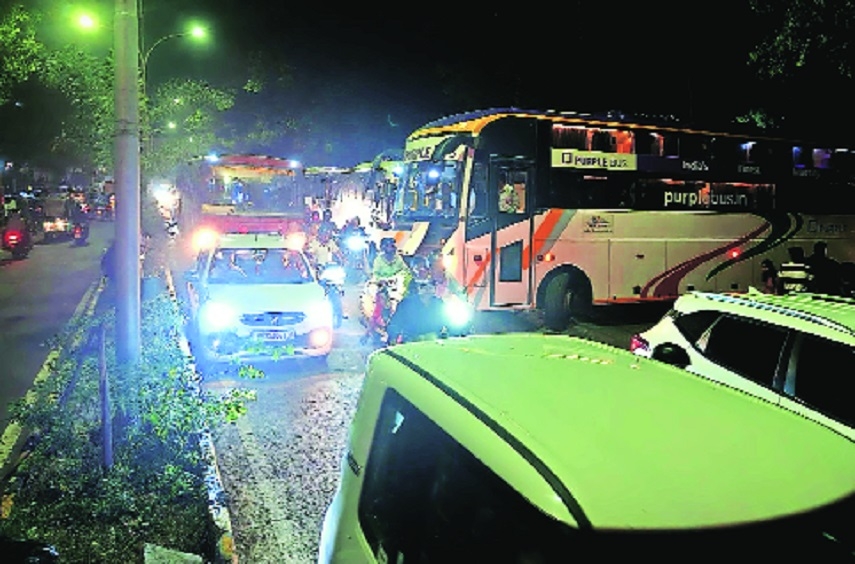
The private buses entering and exiting the private bus parking near Baidyanath Square caused huge traffic congestion on Great Nag Road on Sunday. (Pic by Satish Raut)
By Kunal Badge :
Passengers, motorists face hours-long jam as private buses crowd single-gate parking
The city witnessed severe traffic congestion at Baidyanath Square on Sunday evening after a poorly planned traffic management decision turned a routine travel rush into gridlock. The situation epitomised the proverb, “When vision is short, even good plans stumble.”
The square remained congested for hours as private buses jostled to enter and exit the same small parking facility near Baidyanath Square.
The chaos stemmed from the Regional Transport Office’s (RTO) recent directive banning private buses from picking up and dropping off passengers on city streets between 8 am and 10 pm within the Inner Ring Road area to reduce traffic congestion, except from designated parking spaces. The measure, intended to streamline boarding operations and curb illegal halts,
instead paralysed one of the city’s busiest traffic junctions.
Sunday, being the first weekend after Diwali, saw an unusually heavy rush of travellers heading towards big cities like Mumbai, Pune, and Kolhapur. In response, private operators deployed extra buses to meet the surge in demand. However, nearly most of major operators relied on the same Baidyanath Square parking facility, which has only a single entry and exit gate.
The simultaneous movement of multiple buses between 5 p.m. and 9 p.m. brought the Great Nag Road to a standstill.
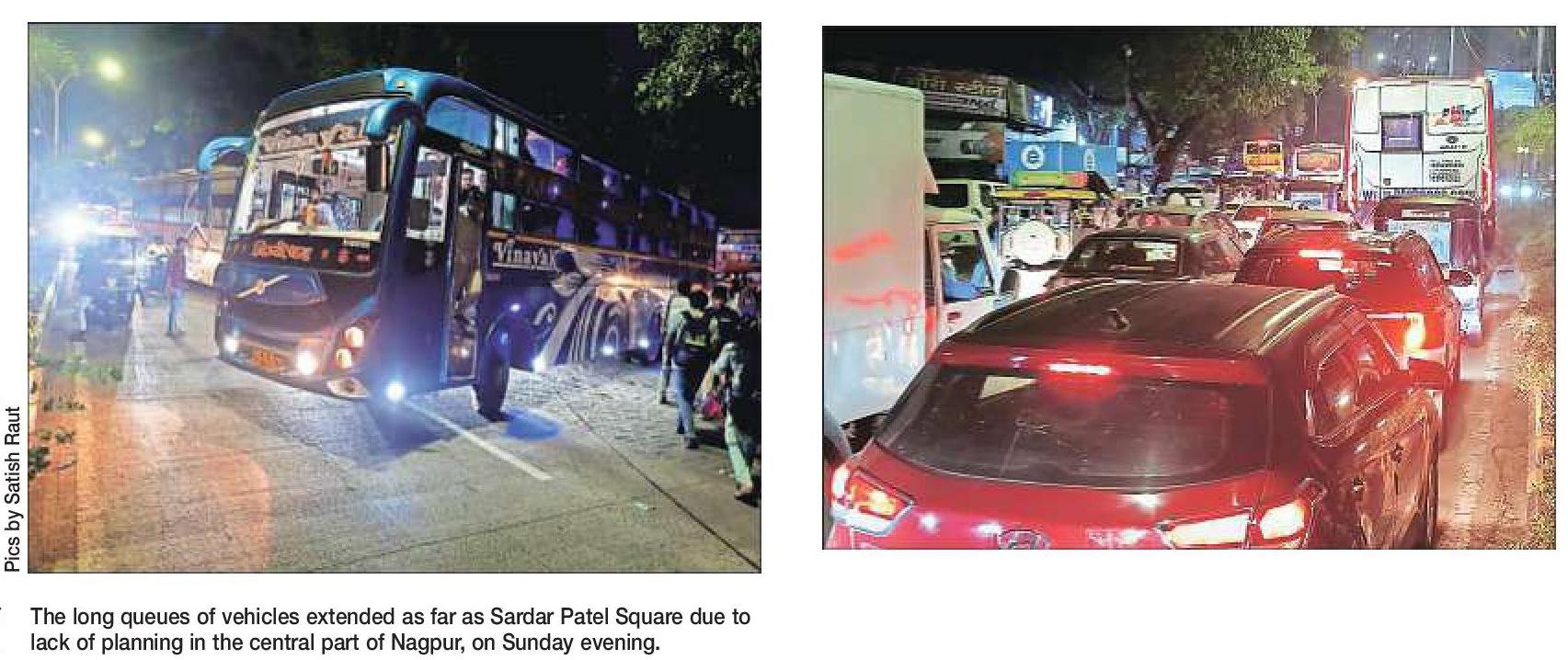
The congestion extended up to Sardar Patel Square near Mokshdham, leaving motorists stranded for more than an hour. Commuters described scenes of complete chaos, buses blocking both sides of the carriageway, auto-rickshaws struggling to manoeuvre, and two-wheelers forced onto the pavements to escape the jam.
“The parking exit opens right onto a busy signal. Every time a bus tried to merge with the traffic, it blocked the vehicles behind,” said a frustrated motorist. “There were no traffic police personnel to manage the flow. It was absolute disorder.”
Adding to the problem, many passengers who previously boarded from multiple city pick-up points were now forced to reach Baidyanath Square.
The concentration of commuters, luggage vehicles, and roadside hawkers further reduced available road space.
While the RTO’s restriction was aimed at preventing roadside boarding chaos, it has inadvertently centralised congestion. Transport experts point out that without adequate infrastructure, a single-site boarding system for dozens of operators was bound to collapse. “Before enforcing such orders, authorities should assess on-ground capacity and peak-hour volume,” noted a local traffic analyst.
By late evening, police were deployed to manually regulate traffic, providing some relief. However, residents and motorists have demanded that the RTO and Nagpur Municipal Corporation (NMC) urgently reassess the parking and boarding arrangements to prevent a repeat of Sunday’s ordeal.
The incident has once again highlighted the recurring problem in city’s urban planning, where well-intentioned administrative measures, lacking foresight and coordination, end up causing more disruption than discipline.