Most ancient culture was ours, says Dr Prabash Sahu
Date :20-Nov-2025
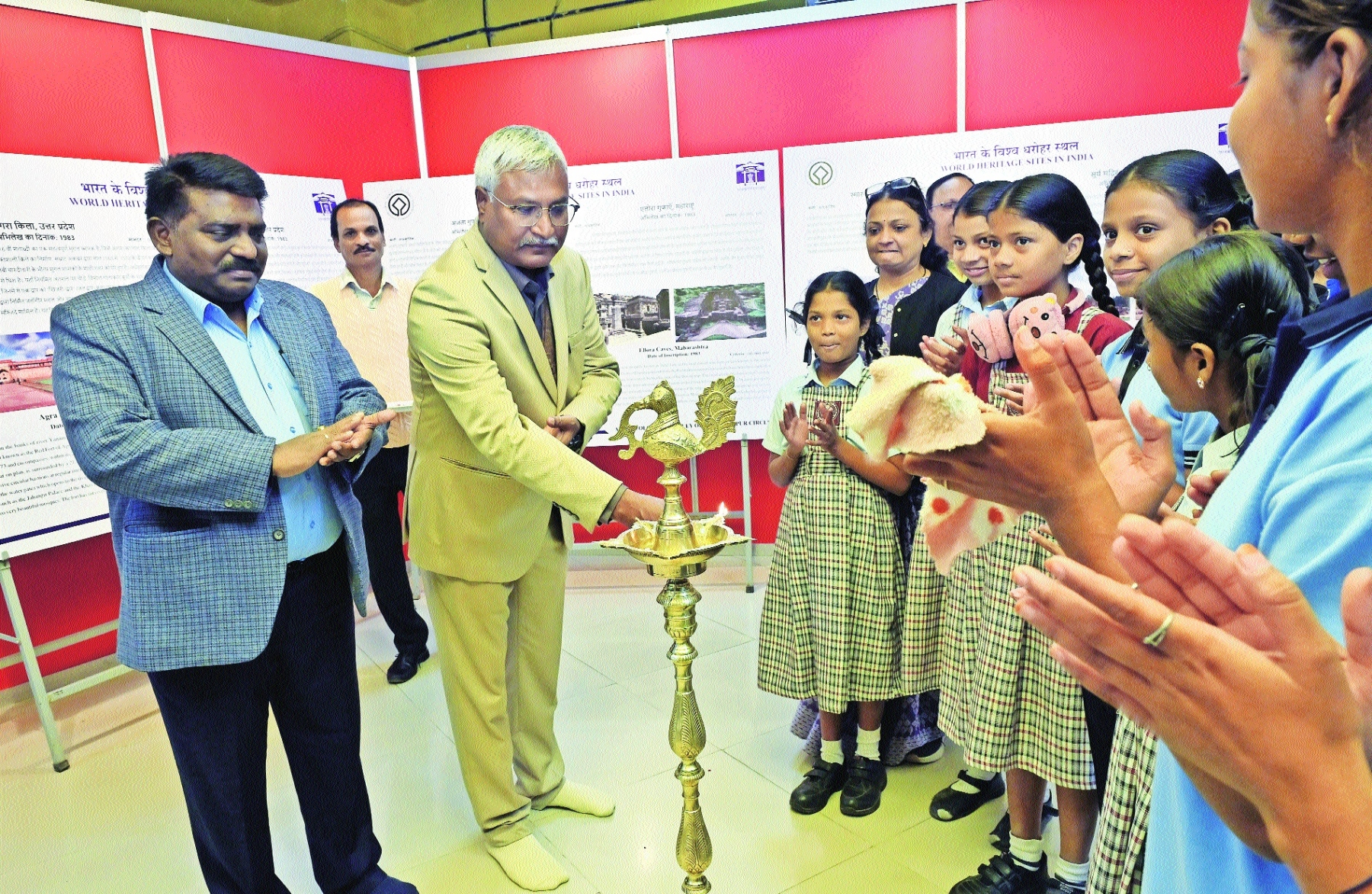
Dr Prabash Sahu, Dr Arun Malik and others during inauguration of the World Heritage Week at Raman Science Centre.
Staff Reporter :
Dr Sahu and Dr Malik stress urgent need to protect fading heritage
“The most ancient culture was ours” with this emphatic assertion, Dr Prabash Sahu, Professor and Head of the Department of AIHC and Archaeology, RTMNU, opened the inauguration of World Heritage Week at the Raman Science Centre and Planetarium on Tuesday. His words set the tone for a programme that repeatedly underscored the fragile state of India’s heritage and the responsibility shared by institutions and citizens alike.
Speaking at the unveiling of the photo exhibition ‘World Heritage Sites in India’, Dr Sahu reminded the audience that the celebration of Heritage Week dates back to 1925, reflecting a century-long global commitment to conservation. He warned that countless heritage sites have already vanished due to encroachment, environmental neglect and unplanned expansion.
“Today we are becoming increasingly greedy for land,” he cautioned, emphasising that heritage protection must be prioritised over short-term developmental gains.
He described heritage monuments as cultural anchors, living testimonies to India’s depth, continuity and civilisational identity.
Dr Arun Malik, Superintending Archaeologist, ASI Nagpur Circle, delivered the second keynote, calling this year’s observance of Heritage Week “special”. Citing recent developments, he highlighted the latest additions to India’s heritage map, the forts associated with Chhatrapati Shivaji Maharaj, notable for their Maratha military architecture and strategic ingenuity.
Malik said heritage sites act as “lessons and memories for future generations”, offering a doorway into history and shaping public understanding of the subcontinent’s evolution. He also noted cultural developments such as the proposed inclusion of the 150 year old poem ‘Vande Mataram’ in national heritage lists.
Students of Maharashtra Adhyayan Mandir and Shri Dadibai Deshmukh School attended the inaugaral programme and also toured the exhibition enthusiastically at the photo exhibition titled ‘World Heritage Sites in India’ for the World Heritage Week.
Reflecting on regional heritage, he pointed to the enduring global significance of the Ajanta, Ellora and Elephanta Caves, while advocating strongly for the Lonar Crater to be granted heritage status owing to its unique geological features.
He credited the conservation of Nagpur’s old High Court building as a positive example of civic intervention and institutional effort.
The event was supported by Charudatta Pulliwar, who helped organise the programme, and Abhimanyu Bhelave, Education Officer at the Raman Science Centre.
The exhibition will remain open until 25 November, offering citizens an opportunity to revisit India’s rich, diverse and threatened heritage.
bbbbbbbbbbbbbb
India’s Heritage Spectrum
n Heritage Week tradition began in 1925
n Ancient sites: Ajanta, Ellora, Elephanta
n Newly added: Maratha Military Forts of Shivaji Maharaj
n Proposed: Lonar Crater; 150 year old ‘Vande Mataram’