‘Irrgn backlog to be wiped out within 2 yrs
| Date :16-Dec-2025 |
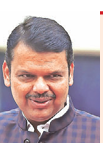
Staff Reporter :
ASSERTINGthat Maharashtra is
going to be first State in the country to achieve $1 trillion econo
my by 2030, Chief Minister
Devendra Fadnavis further
quipped “Maharashtra is marching ahead, it’s not going to stop”,
while replying to Opposition last
week’s motion in Assembly. On
concluding day of Winter
Session, the Chief Minister effectively projected the achievement
”
admit that the monetary position is not that rosy but also not
weak as is being claimed.
At the same time, Fadnavis
declared that within next two
years, State will finally get rid of
concept of backlog as he reeled
off figures of ongoing irrigation
project. The only three districts
having backlog are Akola where
about 14,530 lakh Ha irrigation
capacity is being created against
need for 13.83 lakh Ha.
At
Buldhana,
the
Jigaon
project is going to be game
changer for which Rs 2,399 crore
has been sanctioned with an aim
to created 1.38 lakh Ha irrigation
potential against backlog of
29,000 Ha. The last district with
backlog, Hingoli, has been sanctioned 485 project for tapping 22.31 lakh Ha potential.
Coming to Gosikhurd, of the
2.59 lakh Ha potential, 2.09 lakh
Ha is already achieved and rest
is going to be complete by June
2027. The State has released Rs
1,555 crore for the same. About
Rs 5,950 crore is sanctioned for
deepening Irrigation potential.
Armed with data and backed
by facts, Fadnavis cut short the
tall claims of Opposition who
painted the town red on Saturday,
projecting as if darkness is pre
vailing everywhere.
Countering it on Sunday, Chief
Minister said on the agriculture
front alone, the farmers are going
to get day time power through
tapping of solar energy for which
about 16,000 MW contracts
were issued.
The power is going to come on
stream by mid 2026 and to date
3,000 MW projects are completed. Maharashtra is aiming for
generation of 26,682 MW
through renewable energy
sources.
The advantage of solar power
is that State is going to save Rs
10,000 crore annually due to low
er rate discovered through competitive bidding. At the same time,
Rs 5,500 crore outflow on agri
culture power subsidy is also
going to be saved.
Informing
about the positive outcome of this, Fadnavis said 16,000 MW
solar power generation is going
to massively reduce carbon foot
print and if same was done
through thermal power, then
about 2.75 lakh saplings would
have needed to be planted. In act,
State is anticipating 36,000 MW
generation of green power by next
decade of which 1500 MW will be
round the clock generation.
In fact, Maharashtra is planning to have 82,000 MW contracting of power by year 2030
when demand is going to rise
manifold and of it, 36,000 MW is
going to be green power.
22.31 lakh Ha potential.
Coming to Gosikhurd, of the
2.59 lakh Ha potential, 2.09 lakh
Ha is already achieved and rest
is going to be complete by June
2027. The State has released Rs
1,555 crore for the same. About
Rs 5,950 crore is sanctioned for
deepening Irrigation potential.
Armed with data and backed
by facts, Fadnavis cut short the
tall claims of Opposition who
painted the town red on Saturday,
projecting as if darkness is pre
vailing everywhere.
Countering it on Sunday, Chief
Minister said on the agriculture
front alone, the farmers are going
to get day time power through
tapping of solar energy for which
about 16,000 MW contracts
were issued.
The power is going to come on
stream by mid 2026 and to date
3,000 MW projects are completed. Maharashtra is aiming for
generation of 26,682 MW
through renewable energy
sources.
The advantage of solar power
is that State is going to save Rs
10,000 crore annually due to lower rate discovered through competitive bidding. At the same time,
Rs 5,500 crore outflow on agriculture power subsidy is also
going to be saved. Informing
about the positive outcome of
Similarly, the long-pending
issue of pending agriculture
pumps is history and Fadnavis
happily informed House about
Guinness Book of Records by
MSEDCL for affixing 45,110
pumps.
“In fact, Maharashtra is
going to be leader in pumped
storage generation and same
would help in stabilising grid.
While we have signed accord for
76,000 MW of power and aim to
scale them to 1 lakh MW. Our
requirement is only 8,000 MW
and rest of the power is going to
be exported to national grid helping it stabilise the frequency. Of
this 25 per cent will be through
on/off option which is best suit
ed for grid stability requirement,”
Fadnavis said.