Who let the leopard in?
| Date :21-Dec-2025 |
By Aasawari Shenolikar :
We all are aware that the planet is suffering. But man, ingenious man, is always striving to make life more bearable for the living beings. Haven’t we managed to so spectacularly manage and control pollution, traffic, population, and of course corruption? There’s a hitch here though. All this is only on paper. Reality speaks a different language.
Recently, after weeks of debates and discussions on one grave issue dogging mankind, it seems the time has finally arrived for us to negotiate with Nature. Not that we haven’t interfered with Her enough. But this time, the focus is on Panthera pardus, commonly known as the leopard, a highly elusive wild cat that suddenly is not so elusive anymore. Frequently making appearances in colonies, slyly snatching dogs that are sleeping peacefully, or when confronted with Homo sapiens, lashing out at them, the leopard is a hot topic – so hot that most of the winter session in Nagpur was dedicated to the leopard and its appearance.
IN JEST
‘Sterilise them so that we can control the population,’ was a suggestion. This was picked up by authorities, for this seemed to be the best possible way to manage and control the ferocious cat. And the government, in all its infinite wisdom, came up with, “Permission granted for sterilisation of five leopards, followed by a review after three years.”
Whaatt?!! Incredulous! Preposterous!
Do the math, people. In the three years, these ‘sterilised’ leopards will romp around, but they will not be able to produce progeny. But then the forest is not home to only these five leopards. Do the authorities think that the rest will wait patiently and practise family planning voluntarily? By the time the review committee finishes its first PowerPoint presentation applauding the initiative, the remaining leopards would have already produced a small joint family, complete with siblings, cousins, grandparents, and who knows, a WhatsApp group.
Which brings me to the real question - who has given man the right to redesign Nature? Haven’t we already done a lot of irreversible and irreparable damage?
I am no expert, but as a literate, well-read person, I am aware that sterilisation is not equivalent to wildlife management; it is not conservation.
And history is full of examples that whenever humans started ‘correcting’ nature, Nature responded, and not so favourably.
The Yellowstone National Park experiment tells us that when wolves were removed from the park, it didn’t bode too well for the Park. Deer multiplied. Outcome – vegetation vanished. The adverse effect of this – riverbanks collapsed. The entire ecosystem of the park collapsed. Studies and surveys revealed the grave mistake, and correction methods were employed. Wolves were reintroduced. The ecosystem healed – probably the wolves understood the balance better than the planning authorities.
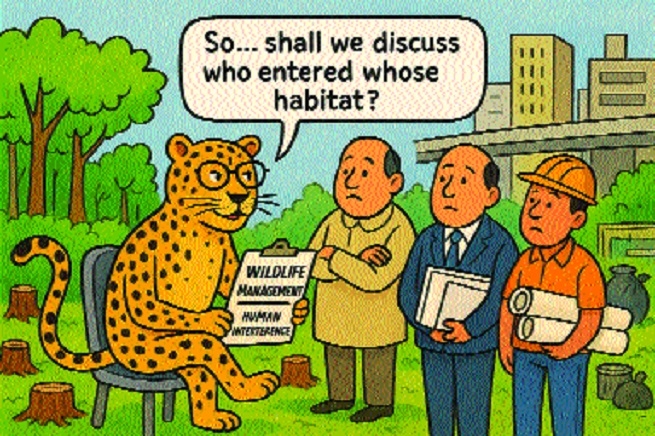
We don’t want the balance to be skewed, so let’s give a thought to why the leopards are behaving the way they are. They are entering cities because we entered forests first – tentatively at first, then aggressively, and finally with full abandon, cutting down trees and constructing buildings and flyovers. Did the leopard apply for an Aadhar Card and shift to urban living and killing? No, we were the ones who moved the cities closer to the jungles, one illegal or legal layout at a time.
As this situation has become truly ominous, solutions and suggestions are flying in thick from all sides. Let’s take a look at a few of them.
Suggestion One: Feed leopards stray dogs. Clap, clap – this is civic innovation at its finest.
“There’s nothing wrong in it. Our cities are facing a huge stray dog menace, which even the apex court has taken note of. This will be like killing one bird with two stones.”
Do I sense the PETA activists getting ready to take action at this suggestion of turning the city into a live buffet? Let us hypothetically say that this could be a good step – what happens when the dog population has been devoured by the cats? Are the leopards expected to pack their bags politely and leave the city premises? Will the leopards not upgrade their menu to the lone watchman dozing off on his chair or the younsgter who insists on jogging at midnight? This is just presumption, for history has shown, time and again, that the predators do not stop at the starters.
Another suggestion that came from an erudite politician – let’s domesticate them. Wow! A die-hard animal lover, I have always felt envious of those rich sheikhs who have these wild cats with golden chains lounging lazily on Persian rugs, gently licking their masters patting hand. I too badly want that.
For a minute this suggestion made sense – when we have domesticated cows, chickens, horses, and occasionally wild husbands too, why not leopards? If the harebrained scheme gets a nod, I can visualise myself walking on the road leading a sleek, strapping leopard on a leash, training him to cross the roads at the zebra crossing. The only minor challenge would be convincing the leopard that it is, in fact, a Labrador.
And now we come to the third proposition. Release goats into forests as prey.
This idea deserves a standing ovation. From the contractors who will get the contract of supplying fat goats. I can see their minds churning as to how they can utilise this opportunity to their benefit.
And then this wild thought crosses my mind immediately – will these well-fed goats, which find a place of pride on any man’s dining table, for mutton is a delicacy, really reach the jungles? Are we expected to believe that the goats will roam freely until obligingly eaten by leopards? More likely, the goats will be eaten long before they reach the forest - by the supply chain itself.
The solution, it seems, is always about quick fixes - never about long-term thinking.
We shrink habitats. We dump waste that attracts prey. Then we act surprised when predators follow dinner into residential layouts. And instead of correcting human behaviour, we attempt cosmetic fixes on animals. Sterilise this. Relocate that. Review later.
A better solution?
The real solution is painfully unexciting: protect forest corridors, stop encroachments, manage waste, educate communities, and build well-planned plan cities.
But that requires discipline, not drama.
And so we prefer ideas involving goats, dogs and surgical interventions - because they sound proactive, even when they are absurd, because admitting human error is far more dangerous.
The leopard, meanwhile, is not confused.
It is simply adjusting to the environment humans have thoughtfully redesigned for it - without taking into account either ecology or common sense.
n