PENCH TIGRESS SHIFTEDto Rajasthan by MI- 17 helicopter
| Date :23-Dec-2025 |
Staff Reporter :
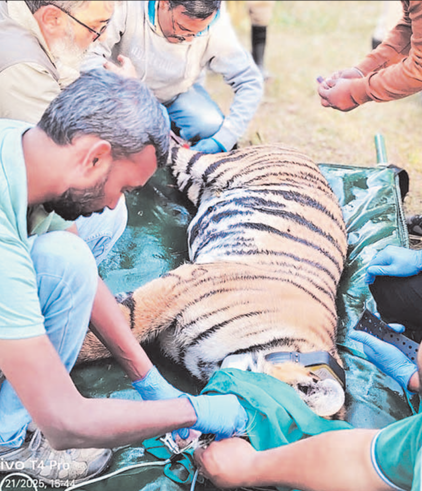
PENCH Tiger Reserve, Seoni has
successfully transported the
three years old tigress to Ramgarh
Vishdhari Tiger Reserve in
Rajasthan, on Monday. The
translocation was carried out
safely using an Indian Air Force
MI-17 helicopter.
This translocation operation
was meticulously planned and
executed over the past one month
following scientific protocols. The
Pench Tiger Reserve manage
ment identified a suitable tigress
and continuously tracked and
monitored her using advanced
AI-based camera traps and
motion sensor cameras. Around
50 cameras were installed in the
area for this purpose.The operation was conducted
in close coordination with the
Rajasthan Forest Department.
Suganaram Jat, Chief
Conservator of Forests, Rajasthan
and Dr Tejinder, Veterinarian, co
ordinated the mission over the
past month and remained pres
ent at Pench Tiger Reserve for the
last eight days to closely moni
tor the operation.
The translocation was suc
cessfully completed under the
guidance of Field Director
Devprasad J., with the support
of Deputy Director Rajnish
Kumar Singh, Pench Tiger
Reserve. The tigress was tranquilised by Dr Akhilesh Mishra
and Dr Prashant, along with the
Wildlife Conservation Trust team,
with assistance from Dr Kajal
and Dr Amol (Veterinary College,
Jabalpur) and Field Biologist
Animesh Chavhan.
During the translocation from
Pench Tiger Reserve to Ramgarh
Vishdhari Tiger Reserve, the
Pench team was led by Mission
Leader and Assistant Director
Gurleen Kaur (IFS), Senior
Veterinarian Dr Mishra,
Veterinarian Dr Prashant
Deshmukh (Wildlife
Conservation Trust) and Range Officer Lokesh Kumar
Chaudhary, Pench Tiger
Reserve, Seoni. They accompanied the Rajasthan officials
aboard the MI-17 helicopter to
ensure the safe transfer of the
tigress, demonstrating effective
inter-state co-ordination and
operational efficiency.
The success of this mission
was significantly supported by
the dedicated efforts of the field
staff from Kurai and Rukhad
ranges of Pench Tiger Reserve.
The staff worked tirelessly,
checking camera traps twice
daily, conducting regular
patrols, and continuously tracking signs of the identified tigress
from 6 am to 6 pm each day.
This successful translocation marks an important mile
stone in strengthening tiger
conservation through inter
state coordination, support
from the Indian Air Force and
scientific wildlife management. It will contribute to
enhancing genetic diversity
across tiger landscapes and
reinforce long-term conservation efforts in India.