SIR hearings underway in WB 32 lakh ‘unmapped’ voters to be covered
| Date :28-Dec-2025 |
Kolkata :
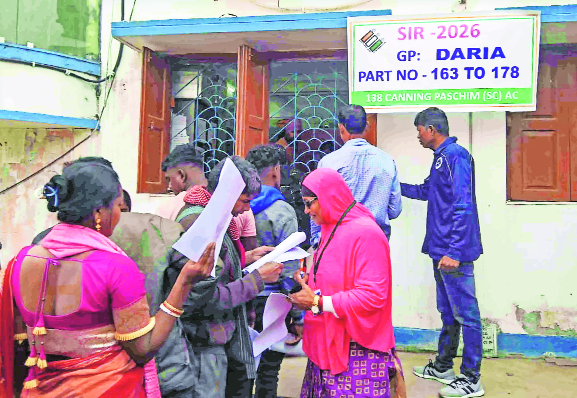
THE hearings under the
Special Intensive Revision
(SIR) of the electoral rolls were underway in West Bengal on Saturday with people queuing up in front of 3,234 centres across the State, a senior
official said.
Around 32 lakh “unmapped” voters, those who are unable to establish linkage with the 2002 electoral roll, will be called for hearings in the first phase, he said.
Altogether 4,500 micro observers have been engaged for hearings in the first phase, which began at 11 am.
Voters can submit any of 12 recognised documents, including Aadhaar, as proof of identity and address, an Election Commission official said.
However, the Aadhaar card will not be accepted as a standalone document, he said.
Those aged 85 years or above won’t have to physically come to the hearing camps as EC officials will undertake the
process at their residences, he said. “The hearing process is being conducted under the supervision of over 4,500 micro-observers, with only authorised officials such as EROs, AROs, BLOs and observers permitted at the centres. People are lining up in large numbers before every camp,” said the official at the office of the State Chief Electoral Officer (CEO).
No changes have been permitted once the hearing centres are finalised, as the measures aim to ensure transparency
and accuracy in the revision process.
The Election Commission (EC) had, on December 16, published the state’s draft electoral rolls following SIR, deleting the names of more than 58 lakh
voters on various grounds, including death, migration and
non-submission of enumeration forms.
‘We hope our names will not be deleted,’ say unmapped voters at first-day SIR camps in West Bengal: HEARINGS under the Special Intensive Revision (SIR) of electoral rolls began across West Bengal on Saturday, with thousands of ‘unmapped’ voters queueing up at camps amid confusion and anxiety over discrepancies in their voter details, officials said.
Ankita Mukherjee, a software professional working in Chennai, had to rush to her hometown Barasat in North 24 Parganas after receiving a notice from the Election Commission to attend the hearing on the first day due to discrepancies in her name that surfaced after she submitted her enumeration form online.
Mukhherjee, who was not an adult in 2002, had submitted the names of her parents but the block-level officer of her native place said her data could not be uploaded digitally due to some technicalities and she needed to turn up at the hearing camp at Colony More booth area of Barasat.
“I had to apply for leave due to the emergency and left behind my eight-year-old child and husband, who also works in the IT sector.
I had voted in the last Lok Sabha and Assembly polls as there was no need of SIR. However, I am not complaining,” she said.
Mukherjee, while leaving the camp, sounded confident that her name will figure in the final rolls which will be uploaded in Februaary.
At camps across the State, elderly voters were seen struggling to attend hearings. At Bhawanipur’s Mitra Institution camp, a 75-year-old man with walking difficulties said he was called due to spelling discrepancies in his surname despite his name figuring in the 2002 rolls.
“I had submitted all the details and even had my name in the 2002 list.
I was still told by the BLO that there is a confusion about my surname’s spelling in the form. He asked me to come and I am here with all the documents. Let’s see,” he said, refusing to give his name.
In Birbhum’s Bolpur, 62-year-old Soumitra Mitra, who had worked in Nagpur for years before returning to West Bengal, said he faced difficulties due to lack of voting records from before 2002. “I returned in 2016 and got the EPIC card and other documents in the present address.
However, as my parents died before 2002 and there were no records of my voting in Maharashtra, I could not fill up the enumeration form,” he said.
“Finally, today I came up with higher secondary admit card, date of birth proof and ‘parcha’ of residence here. The micro observer told me not to worry,” he said.
Eighty-year-old Ambika Mukhopadhyay from Hooghly and 76-year-old Sabitri Majumdar from Purba Bardhaman appeared distressed as they were guided through the hearing process. Sabitri said she had submitted Aadhaar, voter card, ration card, residence proof and utility bills but was unsure why she was called.
“I have no idea why I have been called. I voted in earlier elections but could not vote in 2002. I have come up with some papers as suggested by the officials and my son,” Sabitri said.
In Khardah, 65-year-old Anju Das, who migrated from Bangladesh in the 1980s and voted in later elections, said she was frightened after receiving the notice.
“I could not vote in 2002 polls but I had voted on later occasions. I am scared,” she said.
Another middle-aged man living in Barrackpore said his name figured in the list of unmapped voters in his area.
“I am not apprehensive. The assistant electoral registration officer told me to come tomorrow to hear my case. I am a citizen of this country and have my father’s and mother’s names in electoral rolls.
But due to some spelling discrepancies in my surname, I was marked unmapped. I know this will be corrected and I can exercise my franchise anytime after February 2026,” he said.
At Panihati, around 100 unmapped voters attended the hearings.
A senior election official said hearings were held at 3,234 centres across the state on Saturday. Around 32 lakh unmapped voters, those unable to establish linkage with the 2002 electoral rolls, will be called in the first phase.
The Election Commission had published West Bengal’s draft electoral rolls on December 16 after the SIR exercise, deleting over 58 lakh names on grounds including death, migration and non-submission of enumeration forms.