Desh’s 1st woman PM Khaleda Zia no more
| Date :31-Dec-2025 |
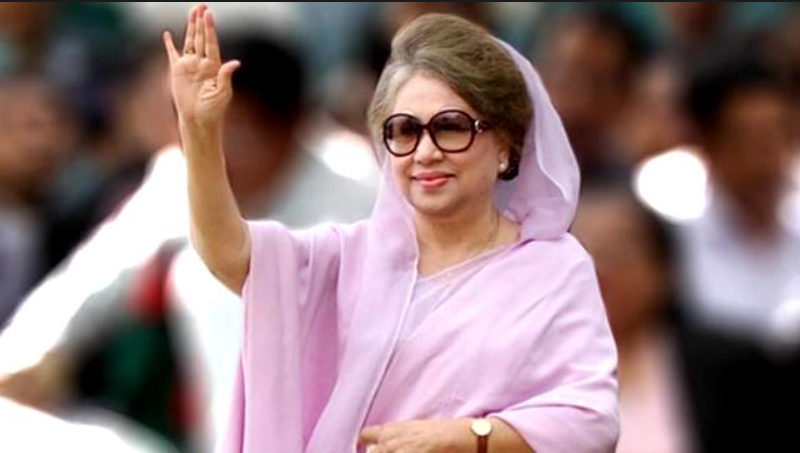
BANGLADESH’S first woman
Prime Minister Khaleda Zia,
who played a major role in
restoring democracy after a
period of tumultuous military
rule and dominated the country’s politics for decades, died
on Tuesday after a prolonged
illness. She was 80.
“My mother is no more,” Zia’s
elder son and Bangladesh
Nationalist Party’s (BNP) acting Chairman Trique Rahman
said. Zia was a three-time
Prime Minister and held the
position of chairperson of BNP.
Her personal physician, Dr
AZM Zahid Hossain, said she
breathed her last early on
Tuesday while receiving
treatment at Evercare Hospital
in Dhaka.
Zia’s family members,
including her elder son Tarique
Rahman, his wife Zubaida
Rahman, and their daughter
Zaima, were present at the hospital. BNP Secretary General
Mirza Fakhrul Islam Alamgir
was also at the hospital.
Her party said she passed
away at 6:00 am local time,
“just after Fajr prayer”.
Zia’s funeral will be held on
Wednesday after Zohr prayers
at Parliament’s South Plaza and
the adjoining Manik Mia
Avenue, Law Advisor Asif
Nazrul said.
She will later be laid to rest
with full State honours beside
the grave of her husband, former President and BNP
founder Ziaur Rahman, at Zia
Udyan in Sher-e-Bangla Nagar
in Dhaka, Nazrul told reporters
after a special meeting of the
interim Government’s Advisory
Council at the State guest house
Jamuna. BNP Secretary General
Mirza Fakhrul Islam Alamgir
attended the meeting as a special invitee. BNP also declared
seven days of official mourning following the death of its
chairperson.
Chief Adviser Muhammad
Yunus announced a three-day
State mourning and a one-day
general holiday.
“At the death of former Prime
Minister Begum Khaleda Zia, I
declare three days of state
mourning and a one-day general holiday tomorrow on the
day of her Namaz-e-Janaza
(funeral prayers),” he said.
Yunus urged people to maintain discipline and order during the funeral prayers and the
observance of mourning across
the country. Bangladesh’s
deposed Prime Minister Sheikh
Hasina also expressed condolences over the death of her
archrival Khaleda Zia.
In a condolence message
posted on the Awami League’s
X account on Tuesday, Hasina
described Zia as a significant
figure in the country’s political
history.
The 78-year-old Awami
League leader highlighted her
role as Bangladesh’s first
woman Prime Minister and her
contributions to the struggle to
establish democracy.
Zia had been suffering from
multiple complex and chronic health conditions and infection-related problems.
She was admitted to Evercare
Hospital on November 23 for
routine tests, during which
doctors detected a chest infection and decided to keep her
under observation.
Her condition worsened on November 27,
prompting her transfer to the
hospital’s Coronary Care Unit
(CCU). In the early hours of
Tuesday, Dr Hossain, who was
also a member of the medical
board overseeing her treatment, described her condition
as “very critical”. As her condition deteriorated, Rahman,
along with other family members, rushed to the hospital.
Zia last appeared in public on
November 21 when she joined
the Armed Forces Day reception at Dhaka Cantonment. In
his condolence message, Chief
Advisor Yunus said he was
“deeply saddened and griefs tricken” by the passing of Zia,
noting that the nation had lost
not just a political leader but a
towering states woman who
represented an important
chapter in Bangladesh’s history.