1,200 yrs old Karpur Baoli near Ramtek on verge of extinction
Date :08-Dec-2025
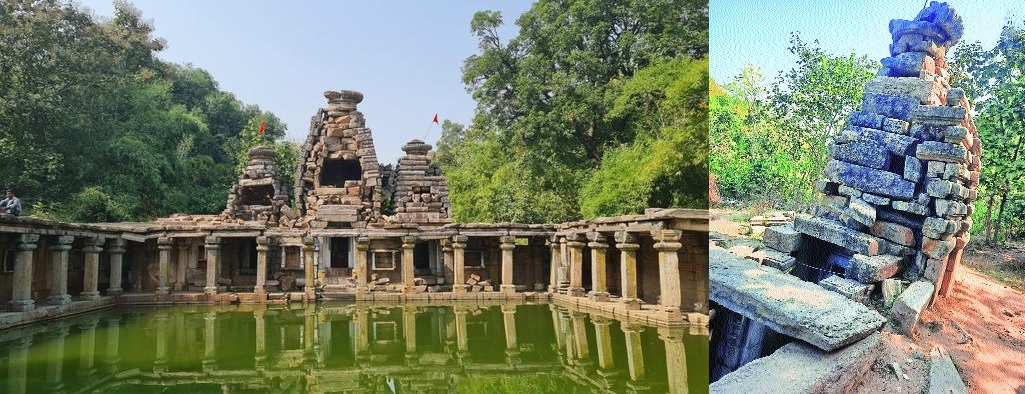
Dilapidated structure of Karpur Baoli near Ramtek.
By Vijay Pande :
Karpur Baoli, a 1,200-year-old stepwell located in the dense forests at the foothills of Sindhuragiri, north of Ramtek Gad Mandir, is facing severe neglect and is now on the verge of extinction. Despite its historical and architectural importance, the administration has failed to protect and preserve this heritage structure.
Built during the Yadav period, the Baoli is situated about 1.5 km southeast of the Jain temple in Ramtek city. It represents the Hemadpanthi architectural style. The Baoli is mentioned as Karpoorvapi or Karpur Baoli in the inscription of the Lakshman Swami temple and also finds reference in the Sthanapothi of the Mahanubhav Panth.
Water had camphor-like fragrance
In ancient times, the water in the Baoli had a
natural camphor-like fragrance, which earned it the name “Karpur” or “Camphor” Baoli. It was originally built as a drinking water source. Later, residents of Ramtek and nearby areas used it for swimming during the summer. When full, the Baoli also served as a source for irrigation for local farmers.
However, over the years, due to neglect and lack of maintenance, the Baoli has filled up with garbage, stones, mud and silt from the surrounding hills. Three Hemadpanthi temples located on the western side of the Baoli also are in a ruined condition. British writer Cunningham had mentioned these temples in the Archaeological Survey of India report.
27 broken pillars
The Baoli is square in structure, measuring 23 feet on each side. It once had a ‘sabha mandap’ around it, supported by nine pillars on each side. Today, only 24 standing pillars and 27 broken pillars remain. The depth of the Baoli, estimated to be around 2 metres, is no longer visible due to accumulated silt. A temple of Satsara Devi stands on the western side, believed to be associated with the Shakti tradition. Though the Archaeological Survey of India (ASI) is responsible for its maintenance, progress has been slow. A few years ago, the Government sanctioned Rs 6 lakh under the Warsa Jatan Yojana to clear the Baoli. While cleaning was briefly carried out, the structure again filled with silt after the rains.
Baoli on forest land
Adding to the problem, the Baoli lies on forest land. The ASI has requested the Forest Department to allot the land to them, but no decision has been taken yet. The Forest Department has also dug a deep drain at the beginning of the approach road, blocking vehicle access. Visitors now have to park their vehicles 1.5 km away and walk to the site. Forest officials claim the drain was created to stop illegal activities and crowding near the Baoli.
Due to lack of funds, bureaucratic delays and poor coordination between departments, this historic structure is slowly disappearing. If timely conservation work is not undertaken, future generations may know Karpur Baoli only as a story - “There once was a Baoli here.”