Narrow escape for a sculptor carver
| Date :29-Apr-2025 |
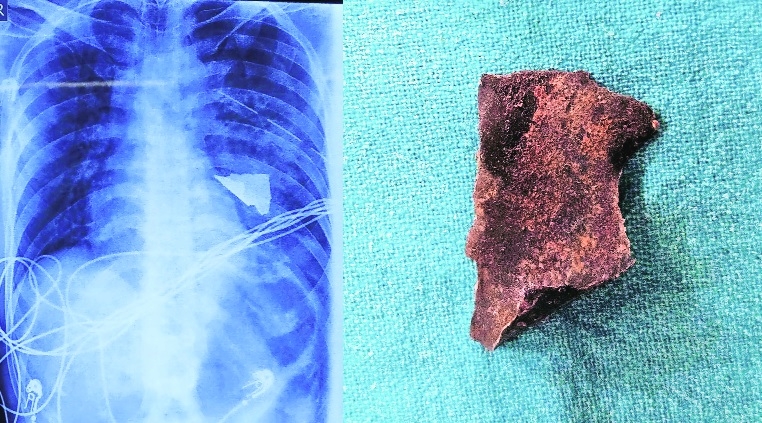
The metalic fragment is visible in X-ray. (Right) It is kept on the table after removing it from lung.
Staff Reporter :
- SSH docs remove metallic fragment from lung in rare surgical case
- The patient was a chronic tobacco chewer with severely restricted mouth opening, making airway management and intubation extremely difficult
In a rare and challenging case, a young man employed in heavy metal smelting, who was a sculptor, was successfully operated on after a high-velocity, triangular-shaped metallic fragment penetrated his chest wall and lodged into his left lung. The team of doctors at Super Speciality Hospital removed the metal from the lung.
The patient presented in a critical condition with haemopneumothorax, active bleeding from the entry wound, and signs of shock.
Complicating the case further, the patient was a chronic tobacco chewer with severely restricted mouth opening, making airway management and intubation extremely difficult. Despite these challenges, the anaesthesia team successfully performed lung isolation with a bronchial blocker. As the left lung had to be deflated for a clear and easy approach for the removal of the metallic piece, air entry was blocked in the affected lung, which was deflated and isolated.
The 5×3 cm piece of metal managed to pierce the chest wall and get lodged deep inside the left lung in the upper lobe. Miraculously it missed the heart and all the major vessels in the chest, although a small piece of the lung had to be removed, as it was shredded beyond repair by the shrapnel.
The surgical team removed the foreign body with great precision. The patient is currently stable and recovering well post-operatively.
This patient was a typical victim of occupational hazards which workers usually face in their workplace as a result of their job duties. These hazards can affect a person’s health, safety and well-being.
It was a concerted effort of Anaesthesia and Surgical teams with the help of experienced and well-trained nursing staff and attendants.
The Anaesthesia team comprised of Professor and Head of the Department, Dr Lulu Fatema Vali, Assistant Professors, Dr Mohanish Badge and Dr Alfa Telang, Fellow and Senior Resident, Dr Aditya Rao, Junior Resident, Dr S. Kishore.
Surgical team included Professor and Head of the Department, Dr Satish Das, Assistant Professors, Dr Kunal Rawekar and Dr Ritesh Mate, and Dr Aneesh Lawande.
The nursing staff included Brother Sarang Chambhare, Sister Manju Gaikwad and Sister Pranita Parjane. Attendants Radheshyam Kokarde and Sanjay Vaidya provided able support.
The patient was a case of
polytrauma who was admitted to the Trauma Care Centre, Government Medical College and Hospital, initially and was managed efficiently under Dr Abdul Qureshi.
Then the patient was shifted to Superspeciality Hospital and Postgraduate Institute, GMCH, for the removal of a foreign body in the lung.
The credit for the successful outcome of the patient goes to the Dean of the Institute, Dr Raj Gajbhiye; Medical Superintendent Dr Avinash Gawande; and OSD of SSHPGI, Dr Sushma Thakre.