Of the source of art
| Date :29-Apr-2025 |
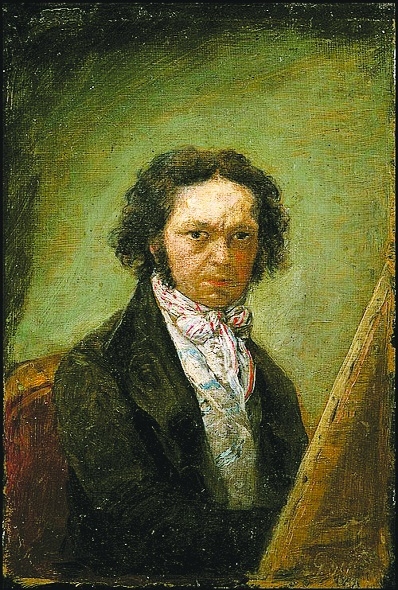
A self-portrait by Francisco GoyaBy Vijay Phanshikar :“In art, there is no need for colour; I see only light and shade ... Always lines, never forms ! But where do they find these lines in Nature ? For my part, I see only forms that are lit up and forms that are not (lit up). There is only light and shadow ...”- Francisco Goya,the legendary Spanishromantic painter, graphic artist,(1746-1828).
WHAT a contemplation ! -- Complex, even confusing ! Is this how art gets created or crafted or sculpted ?
But when a Francisco Goya says this, then the thought assumes an altogether different importance. For, even though he was known to be an artist of the romantic category, Francisco Goya produced art with a clear surreal touch -- as if the work emerged from the deep layers of his conscience, as if almost on its own without any goading from the artist, without any pre-determined or advanced ideation. His art seemed very internal to him, very personal to him -- and very spiritual despite its romantic facade. Goya’s art stemmed from the deepest core of his inner being. That was, therefore, the reason why his works have a surreal touch, a collaboration of boundaryless forms neatly tugged and tagged together to effect an expression.
That was hardly a physical process. For, Goya’s mind did not recognise the
surrounding bound by lines -- which most people normally do. He recognised forms, so to say, quite loosely indicated by blobs of light or shade (or ‘shadow’, in Goya’s own words). Those blobs assumed shape -- and forms -- as per the artist’s perception,
precept, cultural and mental imagery, and finally imagination.
But on this count -- of imagination,
elsewhere Francisco Goya said, “Imagination without reason produces impossible
monsters; with reason, it (imagination) becomes mother of the arts, and the source of its marvels”.
What a tremendously deep and
contemplative approach to art as a fine human expression ! And how true ! For, haven’t we seen really monsters stemming from imagination unrestrained by reason of uncouth humans ? That creation cannot be called art. But there are people who would insist that that, too, is art. But men and women of the calibre and depth of Goya do not join that school.
They insist, imagination without reason -- that ability to decide right or wrong, good or bad -- is capable of
producing monsters that finally devour humanness.
Considered in totality, Francisco Goya defines what the source of art is -- a
reasoned imagination that refuses to get swayed by restricting lines, but suggestive blobs of light and shade that assume shape in the work of art as per the artist’s ability to poeticise images, so to say.
Of course, many other artists may not agree with Goya. They will have another definition of the art and its source, all right. Yet, it is obvious that Goya offers to human thought a credible point of reference to context of art as human
expression of an enduring -- and endearing -- value, emotional and spiritual.
Of course, Goya goes still further -- he refuses to acknowledge the need of colour as an input of art. In other words, this approach can be interpreted as something in which colour appears in a work of art as an extension of the artist’s inner play of imagination -- which does not necessarily require colour as a defining dimension of art. In still other words, art may have no colour at all. Yet, even in that case of extreme minimalism, a work of art can have its own appeal, its own magnetism !
In summing up, one can safely and easily infer that the quality of any work of art depends on what kind of inner
interpretation it stirs up in the mind of the connoisseur -- at a given time, and in a given cultural context.