Flight for vulture conservation Satellite tagging begins at Indravati Tiger Reserve
| Date :13-May-2025 |
Our Correspondent
BIJAPUR :
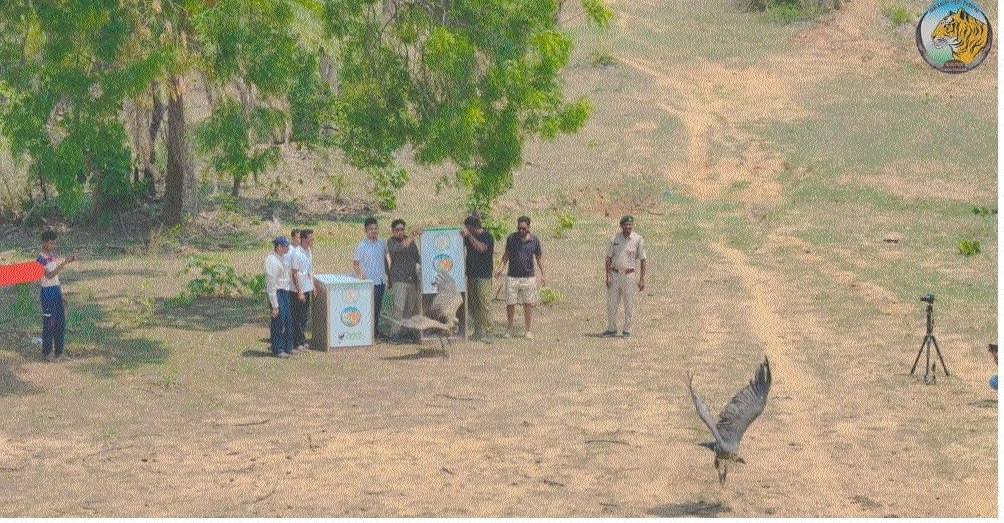
IN a pioneering conservation move, Chhattisgarh has launched a scientifically driven effort to track and protect vultures, a critically endangered species across South Asia, by deploying satellite tagging and ringing at the Indravati Tiger Reserve (ITR) for the first time.
The initiative, a collaboration between the Chhattisgarh Forest Department and the Bombay Natural History Society (BNHS), has marked a major step in using advanced technology for wildlife conservation.
Scientists tagged the Indian Vulture (Gyps indicus) and the White-rumped Vulture (Gyps bengalensis) with satellite transmitters and identification
rings, setting in motion a long-term monitoring protocol designed to inform both research and policy.
Equipped with GPS transmitters, the tagged vultures will now generate real-time data on their movement patterns, migratory routes, nesting behaviour, and even mortality indicators.
The high-resolution data is expected to play a crucial role in understanding habitat preferences and identifying ecological threats—vital inputs for shaping future conservation strategies at both state and national levels.
The tagging exercise was recently carried out under the supervision of noted wildlife expert Sachin Ranade (BNHS) and field biologist Suraj Nair from ITR, with clearance from the Ministry of Environment, Forest and Climate Change (MoEF&CC) and in compliance with international scientific protocols.
Notably, the vultures, once a ubiquitous presence across Indian skies, have witnessed a precipitous decline in recent decades—largely due to the veterinary drug diclofenac, habitat degradation, and food chain poisoning. The newly- launched tagging programme is expected to generate insights critical for inter
ventions such as chemical bans, habitat restoration, and safe feeding zones.
The groundwork for the operation was laid under leadership of Forest Minister Kedar Kashyap and under the guidance of Principal Chief Conservator of Forests (Wildlife) Sudhir Kumar Agrawal (IFS), and executed locally by ITR Director RC Dugga, Deputy Director Sandeep Balga, and Bijapur DFO Ranganath Ramakrishna Y.
Described by conservationists as a potential national model, the project is being closely watched by wildlife circles as a replicable framework. The application of satellite telemetry in tracking endangered species could open new frontiers in conservation science. This is not just about vultures—it is about bringing back balance to ecosystems through data-led policy, a senior researcher said, expecting that if successful, the Chhattisgarh model could become a blueprint for other biodiversity hotspots grappling with species decline.