Of the purpose of art
| Date :06-May-2025 |
A creation of Kattingeri Krishna Hebbar. (Inset) Hebbar himself.By Vijay Phanshikar :“Art is a mirror to life and society in all its joys, all its struggles, all its aspirations ...”- Kattingeri Krishna Hebbar,the iconic Indian painter(1911-1996).
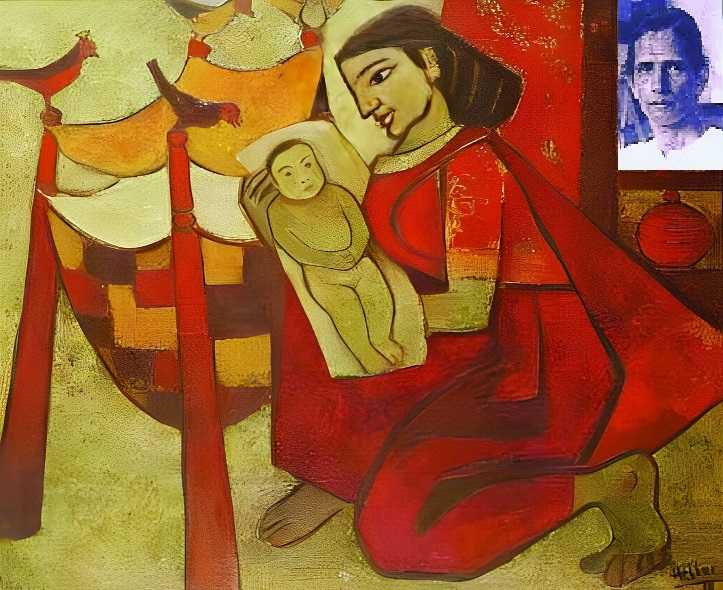
WITH this dominant belief, K.K. Hebbar directed his artistic inclination all his life to hold a mirror to the society. Because of the strong social content, his part became an important tool of cultural renaissance through art for half a century in
post-Independence India. Though he belonged to a
pro-social school of art, Hebbar was still different since he
marshalled his artistic refinement to issue a deeper social message not just to
connoisseurs but also to the larger society.
Such a stand required a lot of courage in those days when art was being treated by the larger world -- mostly western in style and substance -- as nothing but aesthetic
expression of a vague or abstract character. K.K. Hebbar stood on a different ground -- may be in a minority company of artists. Yet, instead of scoffing at such an approach, the world admired him -- and others of his school -- for the simple fact that his art had a strong strand of fierce independence.
His lines were clear, his colours ethnic, his style fluid and his expression vivid. Hebbar was an icon when he was at work. Art was
his medium and beyond that he did not want to foray.
To assert that mere aesthetics could not be the driving force of art, meant something different, something leaning toward the
larger society and its inspirations,
aspirations -- and perspirations. For Hebbar, that was the essence -- beyond mere
aesthetics, beyond the grammar of the art
he pursued.
Some critics might have linked him to some political ideological school. But doing so was rather an injustice to his independent genius.
For, Kattingeri Krishna Hebbar was quintessentially Indian, traditionally Indian, and believed that he should use his heightened artistic
awareness to giving the Indian life an expression of its realism. Despite this, there is nothing political in Hebbar’s approach. He was just an artist -- pure and simple -- who treated his art to be a mirror to the society.
That was the purpose of art, he felt.
To that purpose, he drove his genius all life. In the process, his name attained a
global stature -- across geographies and
cultures. His paintings fetched big prices, all right. Yet, even when that happened, K.K. Hebbar was rather nonchalant about that process. In a flourish of creativity, his genius would produce a piece -- mostly in record time -- after which Hebbar would just
jettison himself from the trappings of his own creations.
That was quintessentially spiritual.