Of the wake -- of memories
| Date :03-Jun-2025 |
By Vijay PhanshikarHoming rowers ...Fading foot-printsIn wake.- Self
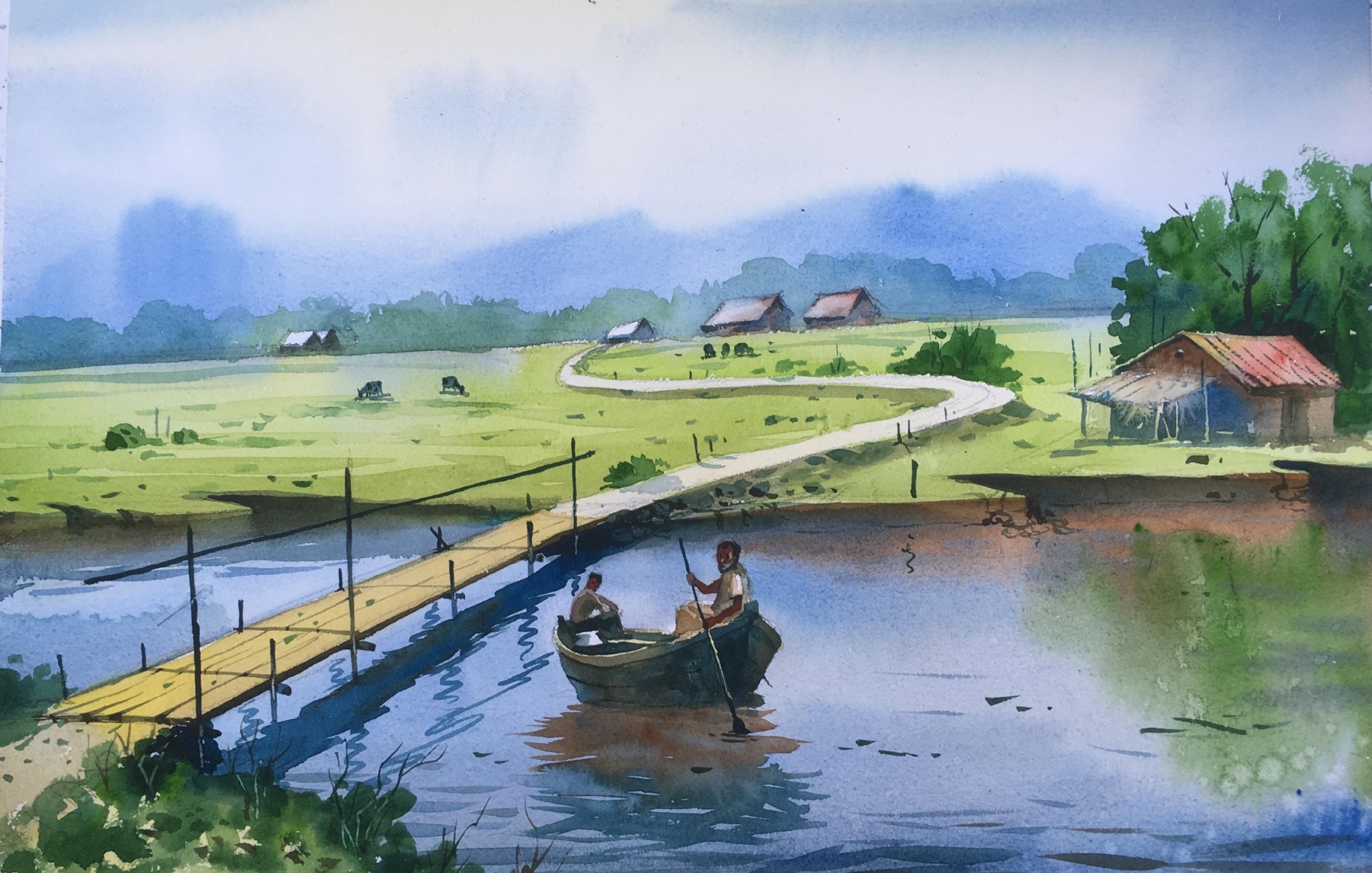
As the light fails and afterhours begin to fall in, like homing birds, rowers, too, return to roost. On the placid, greying waters, the little crafts’ wakes glisten for a moment ... and then merge into the evening’s embrace.
Though familiar to human experience, this sight sparks a vast range of nuanced emotions -- of the journey, of its ups and downs, of its looking forward to destination, and of the wake that lives for quick moments embodying memories of the distance traversed riding on waves.
One should not row after nightfall, they say.
Prose
The waters, then, become sanctuaries of strange spirits in those dark hours, they add. So, as the afternoon gives to evening and the evening to night, rowers in small country crafts return to shores. As their little vessels start slowing down to a stop, the rowers invariably look back on the wake the boats leave behind -- though only for small moments. In that wake, in that vanishing line on the water, experienced
rowers find memory banks that take them back over time they have spent traversing distance on waters in their small crafts. In the wake glistening in the oblique rays of dying evening, they see both, their own foot-prints on waters and also their memories that tend to linger longer than the rapidly vanishing swirl.
For every venturer on any waters, the wake trailing behind has a special place -- like that of the serif in a beautifully written letter-word. Graceful.
Mindful. Almost everybody who traverses on waters -- whether on high seas of great dimensions to massive rivers of eternal lengths to lakes and even ponds -- the wake that the vessel leaves behind has a special place, a signature of its own, a lingering trail of memory associated with not just one journey on waters but also journey of life as such.
Almost everybody who traverses on water in vessel of any shape and size, staring into the vanishing lines of the wake may be sensed as an obsession of sorts.
As one keeps staring at the wake behind the craft, one
unintendedly auto-suggests that the trail is eternal; it really appears so. For, as the vessel moves on, the wake also chases its tail -- as if it is there
permanently, eternally. And when the vessel takes a pause -- if it does -- then the trail also mingles with the waters and moves out of sight. Yet, the image lasts in the mind for long. Many a rower, after homing in, is known to keep dipped in the swirl of the wake that the craft leaves behind -- as a
signature of the distance traversed, a
momentary memento of the memory that almost always refuses to get absorbed in
thin air.