The Man Who Found Narmada Man
| Date :27-Jul-2025 |
By DR ANJAN CHATTERJEE
Onaquiet December evening in 1982,
what first appeared to be a half-ringed
bone on a Narmada riverbed would
soon rewrite the subcontinent’s human
history. It was Dr Arun Sonakia, a paleontologist with the Geological Survey of India,
who uncovered India’s oldest known human
ancestor - later named the Narmada Man. Dr Arun
Sonakia (1945–2018) became internationally
famous for his discovery of a human fossil on
December 5, 1982. The remain, in the form of a
human skull, was discovered from Hathnora village in Sehore, Madhya Pradesh, about 35 kms
east of Hoshangabad, along the Narmada River’s
bank. On the river bed, it first appeared like a
half-ring bone, late in the dusk on December 4,
1982. Since it was getting dark,
Dr Sonakia with
his men left it at that but returned the next morning. Post-excavation, it looked like a hominid cranium, with hidden clues. It soon came to be dated
and tagged as a fossilised human remain of the
Homo erectus species.Abovid (cattle species)
remain found nearby was also dated along with
the human skull using the gamma spectrometric
U-series dating method. This find turned out to be
of the present-day human’s oldest ancestor from
the Indian subcontinent, not less than 236,000
years old. It made a landmark revelation about
human life in this part of the world, leading to the
outdating of theories about the Peking Man, Java
Man, and the African Man, who were earlier
thought to be our ancestors.
Dr Sonakia’s work gained worldwide recognition instantly, and he thereafter worked under the
acclaimed French anthropologist, Prof Henry de
Lumley. He was honoured with National Mineral
Award in 1984–85 for his find and had visited the
USA, Japan, France, Indonesia, and some other
European countries to pursue further interaction
and research with experts. He took efforts to synthesize morphological study data, crucial to
assigning his fossil find an appropriate taxonomic
status.
Dr Sonakia questioned the age-old myth which
says our ancestors of the Indian subcontinent
were Aryans who came from the Middle East -
such is the conventionally accepted demographic
feeder pool. A pertinent question he raised was
about a myriad of artefacts like crude stone tools
known as Paleolithic tools and implements shaped
with refined manufacturing techniques used by
the prehistoric men, found in our country. We
need to think beyond our Indus Valley
Civilizations
of Mohenjo-Daro and Harappa
(3300 - 1300 BCE), Dr Sonakia
contended.
He later worked under the
guidance of Prof Prakash M
Tapaswi at the Geology
Department of RTMNU, Nagpur,
and was awarded a PhD.
Incidentally, Dr Sonakia had
maintained a diary with meticulous records about his find
and about the research he had
undertaken thereafter. He
retired from the GSI in 2005 as
Director, Paleontology Division,
GSI, Nagpur. His death following a tragic car accident on
May 18, 2018 in Hoshangabad
(MP), was a shocker.
Dr Sonakia’s daughter
Shweta, along with her mother
and siblings, wanted the diary
to see the light of day as a good
publication. Dr Ayyaswami,
retired Dy Director General, GSI,
and an acclaimed paleontologist, voluntarily edited the
diary's contents, making it fit
for publication as a book. This
book was released on on July
24, 2025 by the Bhandarkar
Oriental Research Institute
(BORI), Pune.
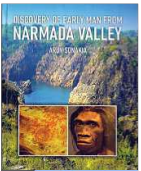
The publication comprises six
chapters with 157 pages. The
first chapter, “Introduction,”
discusses Dr Sonakia’s rendezvous with internationally
renowned paleo-anthropologists, critical examination of his
find by peers being a firsttimer, the subsequent wide
interest generated, and his
invitations to attend international seminars
abroad. Thereafter, it discusses the geological time
scale, origin of life including flora and fauna, evolution of primates, and the position of man on this
evolutionary time scale.
The next chapter, two, is about the history of
human fossil finds with the evolution of hominoid
species in the primate group. Finds like skeletal
human remains from other continents are discussed to build up the genetic tree.
The important third chapter describes the
Narmada Man in detail, with emphasis on different
parts of the skull, their relevance,
and their variations, reflecting on
evolution. Comparisons have been
made with similar finds from other
parts of the globe.
The fourth chapter dwells on the
associated Paleolithic culture,
wherein the implements and tools
used by early humans are
described. They primarily used
these for hunting and mincing
meat. The range of stone and
wooden tools also changed with the
passing years from the rudimentary,
progressing to advanced — throwing light on the then improvisation
timelines.
The fifth chapter, on contemporary fauna, emphasises the nonhominid faunal species identified
and collected along with the human
skull find. These reveal tales about
the range of terrestrial life of the
times and the different hunting
methods of the then hominoids.
The
associated fossil remains also provided valuable clues about the age
of the Homo erectus skull find
under review.
The sixth and last chapter reveals
clues about the potential, prospective, and most likely sites for future
workers in the field to look for
humanoid fossils. River terraces of
Pleistocene Age, approximately
2.58 million to 11,700 years ago, in
locations like river banks and beds,
limestone caves in India, and
coastal sedimentary beds on the
Bay of Bengal and Arabian Sea are
the most prospective.
The book is penned using simple
language and would be an interesting read for students, researchers, geologists,
anthropologists, those from allied fields, and even
laymen — to inspire and motivate their appreciation of humanoid evolution. Field studies on river
terraces of Brahmaputra, Sabarmati, Jhelum, and
Tamirabarani rivers to the east, west, north, and
south respectively could lead to more discoveries
of similar human fossil remains, according to Dr
Ayyaswami, the Editor, who wrote the introduction chapter.
■