monitoring-earth-with-nisar
| Date :10-Aug-2025 |
By CHARVI ARORA :
Monitoring Earth With NISAR :
Accurate and timely data about changes
on Earth is essential for everything
from growing crops to managing natural disasters. That’s where space technology can playakey role.
The NASAISRO Synthetic Aperture Radar (NISAR) mission,
an Earth-observing radar satellite jointly developed by the US National Aeronautics and Space
Administration (NASA) and the Indian Space
Research Organisation (ISRO), is among the most
advanced tools to monitor changes on our planet.
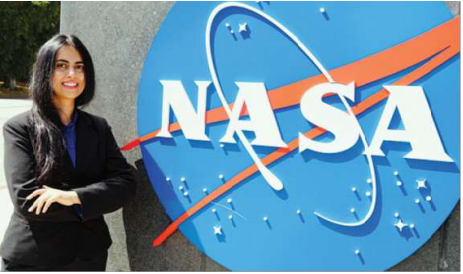
Akshata Krishnamurthy, a scientist at NASA’s Jet Propulsion
Laboratory (JPL), serves as the
science phase lead for the NISAR
mission - one of the key figures
driving the project.
By combining science, engineering and international collaboration, her work supports efforts
to improve food security, disaster
response and environmental
management,
benefiting communities in both India and the United
States.
Excerpts from an interview with
Krishnamurthy.
What inspired you to pursue a
career in aerospace engineering and Earth
observation, and how did your journey lead
you to NASA’s Jet Propulsion Laboratory?
Growing up in India and watching space shuttle
launches on TV in the early 2000s ignited a
curiosity to learn what lies beyond Earth, but also
to understand our own planet better.
That early
spark evolved into a deep interest in working on
technologies that could push the boundaries of
human knowledge. I pursued a bachelor’s degree
in mechanical engineering in India and then a
master’s and Ph.D. in aerospace engineering in
the United States. Driven by the desire to work on
space missions, I specialised in space systems and
instrument development during my Ph.D. at the
Massachusetts Institute of Technology (MIT) and
had the incredible opportunity to work on two
NASA space missions for my doctoral thesis.
My
path to NASA JPL was shaped by years of handson research, perseverance and an unwavering
vision to be part of missions that have real-world
impact. Today, I am grateful to be working on
missions like NISAR that combine science, engineering and global collaboration to benefit millions of people around the world.
Can you give an overview of the NISAR mission and its significance for Earth observation?
NISAR is the first observatory of its kind in
space to systematically map Earth, using two different radar frequencies, L-band and S-band, to
measure changes in our planet’s surface with
unmatched detail and consistency.
The primary
objective of the mission is to track subtle changes
in Earth’s surface that may signal ecosystem disturbances, ice sheet collapse, volcanic eruptions
or landslides. The mission will produceavast
amount of data that will be transformative for scientists, policymakers and communities.
What are some potential real-world applications of NISAR’s data for India and the United
States?
The ability to capture subtle changes in Earth’s
surface will make NISAR an invaluable tool. The
satellite’s observations of forests, wetlands, agricultural fields and soil moisture will be key to
supporting food and water security.
Data from NISAR will also
enable a better understanding of
the dynamics of earthquakes, volcanoes, landslides and coastal
processes such as erosion. This
information will be critical for local
and regional governments to make
informed decisions on protecting
infrastructure and real estate, as
well as community planning.
Given the US-India collaboration on NISAR, what do you see
as the strengths of such international partnerships in space
research?
In my opinion, international
partnerships like NISAR leverage complementary
capabilities, broaden scientific perspectives and
increase access to space-based observations and
data.
They foster long-term cooperation as well as
the sharing of resources and knowledge between
countries. Missions like NISAR help to build a
more robust knowledge ecosystem and demonstrate how science and engineering can unite us
in addressing global problems.
With the fast pace of technological change,
how does NASA-JPL stay ahead in developing
cutting-edge tools and methodologies for
space exploration?
In my experience, innovation is a part of the
culture at JPL. Missions like NISAR are born from
decades of foundational research.
We continuously invest in research and development, working
across disciplines and collaborating with universities, government agencies and commercial companies. We’re always looking ahead, developing
technologies that can support missions a decade
or two from now.
What emerging trends in Earth observation
and space exploration do you find exciting?
I am particularly excited about the integration of
Earth observations with artificial intelligence (AI)
to deliver real-time insights at scale. On the space
exploration front, I am excited about more interplanetary missions with autonomous systems and
human-robot collaboration for exploring the Moon
and Mars. It is a thrilling time to be working in
space exploration. (SPAN) ■