Of the condition at the top
| Date :26-Aug-2025 |
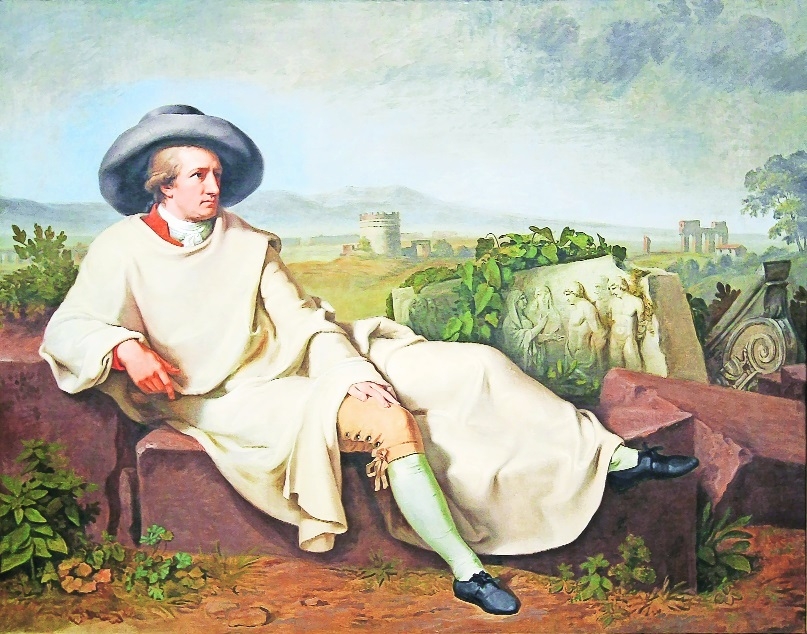
Johann Wolfgang von Goethe
By Vijay Phanshikar :
“ ... Over all the mountain tops is peace.”- Johann Wolfgang von Goethe,Oft-quoted German writer and thinker(1749-1832)
THIS last part of the long statement by the great German thinker has been interpreted variously by various people. So potent are those words -- here translated into English.
One of the interpretations is that when the mountain reaches its full height, it has nothing more to achieve, and so it applies brakes to its own growing taller. In other words, after one has achieved one’s goal, then one has earned a right to take things easy or even rest. So, at the mountain top, things are peaceful !
It would still be interesting to read this full quotation by Goethe:
“Mountains cannot be surmounted except by winding paths. From inaccessible
mountain range by way of desert untrod by human foot to the ends of the unknown seas, the breath of the everlasting creative spirit is felt, rejoicing over every speck of dust that hearkens to it and lives. Over all the mountain tops is peace”.

Through this profound quotation, Goethe (pronounced ‘Gatey’), salutes the restless human spirit of creativity and curiosity and celebration of achievement -- like
surmounting the mountain top via winding paths, like traversing deserts not trodden before. Implicit in the statement is the
restlessness of doing -- trying to do higher and finer things.
But Goethe wants us to note that once you reach the mountain top -- metaphorically, too -- then there is no room for restlessness. For, there is nowhere to go, no higher
height calling.
And of course, we can look at the
imagined scenario from the mountain’s point of view. It has risen to its full
height, full stature, full size.
To reach that point, it has striven, it has forsaken luxury, forgotten small comforts and even
victories. And then comes the
peak -- mountain’s own peak. There, it is all peace -- of highest point, of achievement, of the mental
condition that whatever
challenged one’s spirit had been vanquished. So, here is the point of
rest -- beyond all restlessness.
Possibly in other words, the mountain top points to the limit of growth. Is Goethe
celebrating that ? Not at all. Much to the contrary, he is actually celebrating both, the high point and the high achievement.
He is acknowledging not the limit of human achievement; he is clapping the human
spirit that has the strength of character to do the difficult.
Old American movie ‘Ben Hur’ -- based on ancient history -- portrays an old provincial governor asking a young governor who had come as his replacement in a difficult province. The old man asks, in effect, ‘I am told, you asked for this province so difficult to govern. I am glad, you are relieving me. But, why at all did you select this bad
place ?’
The young governor replies, in effect, ‘Sire, I have been taught that if I want to rise, I must do the difficult’.
Possibly, Goethe is pointing to that spirit.