‘Freedom of expression is guaranteed only if we protect our sovereignty’
| Date :01-Sep-2025 |
Business Reporter :
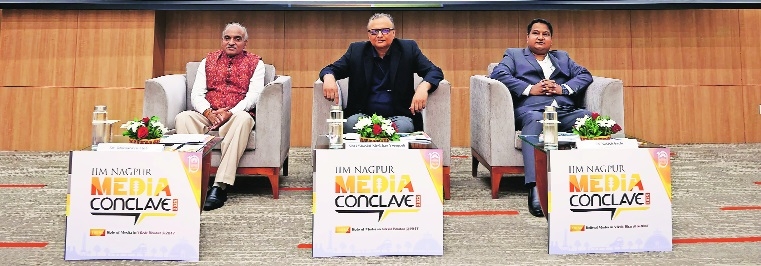
Former CEO of Prasar Bharati and Co-Founder of DeepTech for Bharat Foundation, Shashi Shekhar Vempati, on Sunday, said that national interest should not be set aside while enjoying freedom of expression. Speaking at the inaugural session of the ‘Media Conclave 2025’ organised by IIM Nagpur at its MIHAN campus, he observed that freedom of expression does not exist in a vacuum. “Freedom of expression is guaranteed only if we protect our sovereignty. But if we can’t do so, the term has no meaning,” he said, addressing the gathering of IIM students, faculty members, media representatives and others.
In a bid to highlight the strategic role of media in nation-building as India progresses towards its centenary of independence, the B-school conducted the conclave on the theme “Role of Media in Viksit Bharat @2047”.
Shashi Shekhar Vempati, who was chief guest and keynote speaker of the inaugural session, further said that freedom of expression comes with many challenges.
“While it has advantages, freedom of expression also comes with many disadvantages and invites threats. We have seen several instances in the recent past when foreign media houses ran a series of news stories to build a negative narrative and made attempts to influence local media and people here in the country,” he said.
Vempati categorically highlighted the reports by foreign media on India’s recent military operation against Pakistan. He also remembered BBC’s ‘one-sided’ series of reports on the violence in Delhi in 2020.
Vempati said media platforms can play a major role in the country becoming ‘Viksit Bharat’. However, he added that there is a need to strike a balance between its ‘freedom of expression and responsibility’ to achieve the desired goal.“It is justified to think that natural momentum will make India the world's largest economy. Even as the current geopolitical conditions are favouring India, the growth projections may
change. We cannot take these conditions for granted. In fact, we will have to guard the nation from various threats and do the right things. Otherwise, India will miss the window of opportunity,” he said.
Expressing concerns over the dependency of India media houses on foreign platforms,
Vempati said the country should develop its own system to reach out directly to its audiences.
During the Russian-Ukraine war, the European Union and Canada had banned Russian-backed RT channel, and independent service providers in over 10 countries had suspended its broadcasts.
“To avoid such a situation and protect our sovereignty, we must develop our own technology in this area,” he added.
Earlier in his welcome address, Dr Bhimaraya Metri, Director, IIM Nagpur, spoke about various initiatives of the institute that made it one of the fastest-growing B-schools in the country.
Dr Metri told the gathering that the Maharashtra Government has recently announced the establishment of a satellite campus of IIM Nagpur on 70 acres of land in Pune. “We will also set up our first offshore campus in Singapore in the next two to three years.
Similarly, we are in the process of developing another satellite centre in Hyderabad and a transit campus in Goa,” he said.
Elaborating on the courses, Dr Metri spoke about IIM’s cyber security management programme. “We are the first management institute in the country to venture into training and teaching of cyber security management using data analytics,” he added.
At the outset, Prof. Yatish Joshi, Chairperson – Brand and Media, IIM Nagpur, spoke about the conclave and later on proposed a formal vote of thanks. Riya Goyal and Aneesh Ahluwalia, both students of the institute, conducted the proceedings of the inaugural session. The conclave served as a platform to deliberate on how the media can foster informed citizenship, promote innovation, and shape India’s global image, thereby contributing meaningfully to the nation’s vision of becoming a developed and empowered nation by 2047.