Ganeshotsav to generate revenue of over Rs 500 cr in Ngp distt
| Date :01-Sep-2025 |
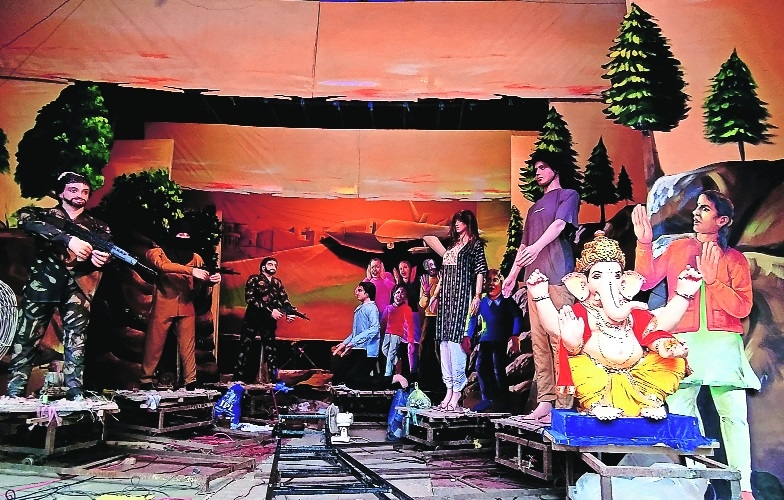
At Gandhi Chowk, Itwari Road, the Ashokstambh Ganeshotsav Mandal has created a striking pandal with the theme of Operation Sindoor. The tableau features life-like human statues portraying Indian soldiers in action against terrorists, capturing the intensity of the operation. At the heart of the scene, Lord Ganpati is depicted as the divine saviour, symbolically protecting the nation’s guardians. The presentation salutes soldiers’ bravery while spreading a message of peace and divine strength, drawing crowds during Ganeshotsav. (Pic by Satish Raut)
By Simran Shrivastava :
Ganeshotsav in city is a faith that also overflows into the arteries of commerce. The deity arrives in clay and colour, but his presence res-hapes many lives along with the economies. This year, the ten-day festival is projected to ignite business exceeding Rs 500 crore in Nagpur city and district.
Financial experts have traced business calculations during the 10-day festival. In Nagpur city, around 1,300 Ganpati idols have been installed, which require expenditure of around Rs 100 crore. Similarly, the district has registered 486 Ganesh Pandals, which could spend around Rs 25 crore.
In Nagpur city, the domestic worship of nearly one lakh households and 14,181 in Nagpur Rural carries an economic weight of around Rs 300 crore. Yet the
celebration extends beyond the pandals.
The season of auspicious purchases fills showrooms with cars gleaming under strings of marigolds, televisions flickering as households upgrade for the festival, jewellery boxes closing with bangles and chains, and consumer goods flowing rapidly into homes. When the streams of household worship, pandal construction and festival shopping are gathered, Nagpur’s Ganpati festival adds Rs 500 crore business in the current economy.
Kailash Jogani, President of the Chamber of Commerce, Nagpur chapter, claimed that flowers, garlands, decorations spread across pandals and homes, festival lighting, idol-making, bands and musicians, sweet shops and prasad preparations, Mahaprasad distributed in vast gatherings and miscellaneous needs such as ghee for lamps, prizes for competitions, and entertainment for processions, account together to give a very huge economy boost through the festival.
On a national canvas, Ganeshotsav holds even deeper economic impact.
Balkrishna Bhartia, National President of the Confederation of All India Traders (CAIT), emphasised that India’s economy breathes through
agriculture and festivals, and when one slows, the other sustains.
He spoke of sculptors who mould soil and straw into divinity, daily labourers who construct pandals with bamboo and cloth, decorators and electricians weaving colour and light, farmers supplying flowers and coconuts, sweet makers working through nights to prepare modaks, and vendors lining pandal streets with food stalls. “Every stage creates employment,” he expressed, “and the money raised inside communities flows back into the same communities, turning faith into circulation and circulation into growth.” In his view, festivals must be understood as stabilisers of the national economy.