Experts raise alarm on rising childhood NCDs in Mah, call for early action
| Date :16-Sep-2025 |
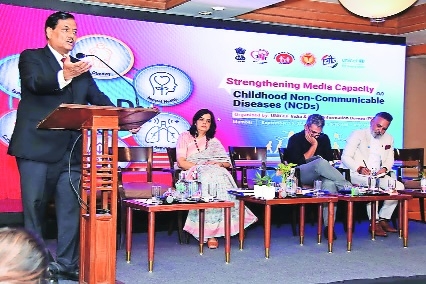
Dr Prof Prashant Joshi speaking at the workshop on childhood NCDs in Mumbai, on Monday. Dr Nipun Vinayak, Smita Vats Sharma, and Sanjay Singh also are seen.
By Kunal Badge :
“Heart attacks and Diabetes occur 10 years before in a patient in India than that of rest of the world,” said Dr Prof Prashant Joshi, Executive Director, and CEO, AIIMS, Nagpur, while speaking at the inauguration of workshop on ‘Strengthening Media Capacity on Childhood Non-Communicable Diseases (NCD)’, organised jointly by UNICEF and Press Information Bureau (PIB) in Mumbai on Monday.
Dr Nipun Vinayak, Secretary, Public Health was chief guest for the programme. Smita Vats Sharma, Director General, West Zone, PIB Mumbai; and Sanjay Singh, The Chief of UNICEF in Maharashtra, were also prominently present for the programme.
Dr Joshi emphasised the importance of early detection of NCDs such as diabetes, hypertension, and obesity—beginning even during pregnancy.
Referring to the Baker hypothesis, he said that undernourishment of the foetus often leads to health complications later in life, worsening India’s NCD crisis. “A womb-to-tomb approach is needed, with cities designed to support healthy lifestyles—walkable roads, green parks, and reduced air pollution,” he added.
Maharashtra is witnessing a silent emergency, with childhood NCDs affecting more than 60 lakh children across the State. Conditions once thought of as adult illnesses—diabetes, asthma, congenital heart disease, sickle cell disease, and obesity, are increasingly common among children. Data shows nearly 2,000 new cases of Type 1 diabetes and 20,000 to 25,000 congenital heart disease cases detected every year. Asthma alone affects about 33 lakh children, while nearly 88 lakh are estimated to be living with some form of mental disorder.
Outlining Government priorities, Dr Nipun Vinayak, Secretary of Public Health, said the State is focused on expanding school-based screenings, ensuring free supply of essential medicines, and strengthening district-level healthcare. “Prevention should begin right from pregnancy at primary health centres. Reaching the most marginalised communities is crucial,” he stated.
Calling NCDs an ‘invisible epidemic’, Sanjay Singh, UNICEF Chief in Maharashtra, said the State’s focused approach to childhood NCDs can serve as a model for other regions. “Every child deserves a healthy and fulfilling life, regardless of background,” he remarked.
Smita Vats Sharma, Director General, PIB (West Zone), stressed that childhood NCDs impact not only health but also education, family income, and emotional well-being. “Children’s health defines the State’s future. No child should suffer isolation because of a manageable disease,” she said.