‘Research must move from labs to people’s lives’
| Date :16-Sep-2025 |
Staff Reporter :
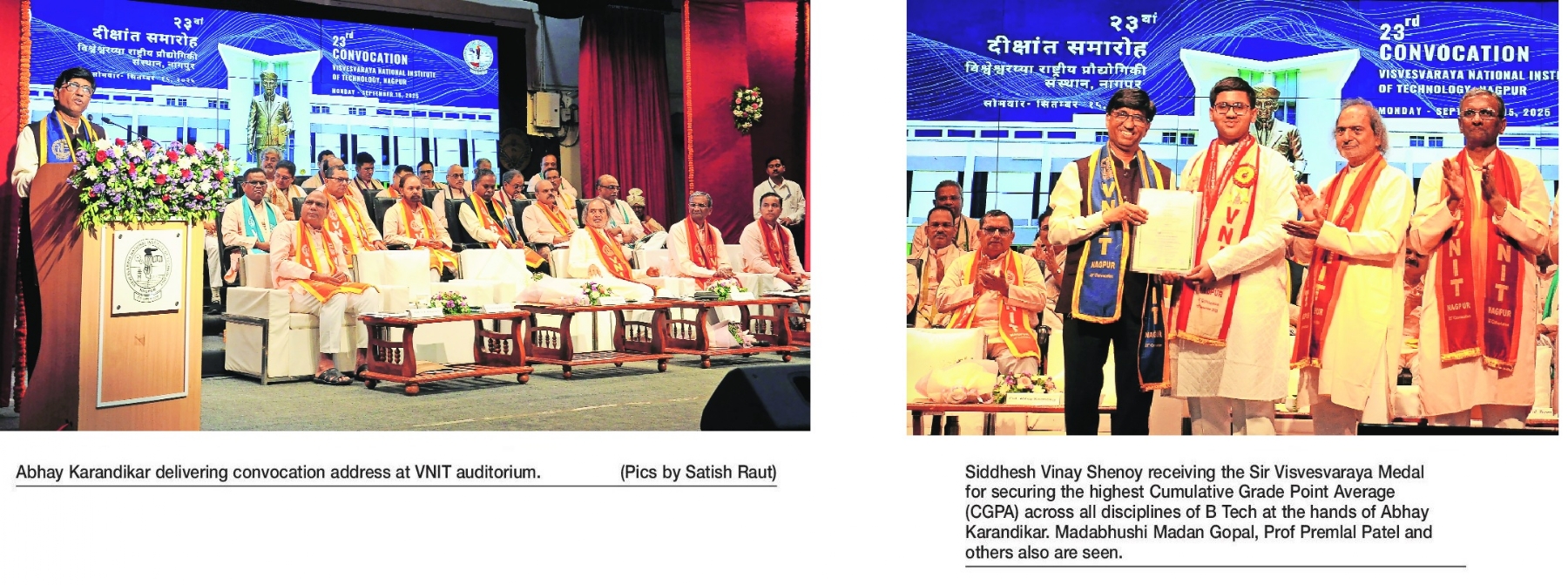
DST Secretary Abhay Karandikar graces VNIT’s convocation
“Research must move from laboratories to the lives of people,” said Abhay Karandikar, Secretary of the Department of Science and Technology, Government of India, as he urged graduates to turn their learning into innovations that touch society. His words set the tone for the 23rd Convocation of the Visvesvaraya National Institute of Technology (VNIT) held on Monday, where the institute celebrated the achievements of its graduating students from engineering, architecture and science disciplines.
The ceremony took place at the VNIT auditorium where the chief guest Abhay Karandikar, who earlier served as director of Indian Institute of Technology (IIT), Kanpur and faculty at IIT Bombay; Chairman of the Board of Governors Madabhushi Madan Gopal; Director Prem Lal Patel, external senate members, deans, registrar, distinguished guests, faculty members and families of the degree recipients were present at the event.
Karandikar spoke about focus areas like artificial intelligence, green hydrogen and sustainable agriculture that align with India’s development goals and mentioned national missions such as the National Quantum Mission, India Semiconductor Mission, IndiaAI Initiative, National Mission on Interdisciplinary Cyber-Physical Systems and National Green Hydrogen Mission. He highlighted women-led development through initiatives like the Women Scientists Scheme and GATI Initiative and called on graduates to drive Viksit Bharat 2047 by creating inclusive solutions, mastering artificial intelligence responsibly and embracing the spirit of service.
He also referred to the Government of India’s recent Rs 1 lakh crore Research and Innovation Fund to strengthen the research and innovation ecosystem.
Madabhushi Madan Gopal emphasised solving challenges like sustainability and technological innovation with inclusive and creative solutions rooted in India’s cultural heritage, and encouraged drawing inspiration from Indian music, art and literature while quoting Swami Vivekananda.
Patel presented the Institute Report which highlighted the achievements of students, faculty and alumni. He urged graduates to contribute to Viksit Bharat 2047 through innovation and service, and to engage with the alumni network to uphold VNIT’s legacy of excellence.
A total of 1,227 students received their degrees at the convocation, including 763 in Bachelor of Technology, 59 in Bachelor of Architecture, 271 in Master of Technology, 63 in Master of Science, 70 in Doctoral programmes and 1 in Master of Technology by Research. The graduates were formally conferred their degrees by the chairman of the Senate.
The event was organised under the leadership of Professor V R Kalamkar, Dean Academics, and the proceedings were conducted by Mangesh Kotambkar and Maihili Paikane. The convocation marked the birth anniversary of M Visvesvaraya, which is celebrated as Engineer’s Day, and stood as a tribute to the spirit of innovation and nation-building.
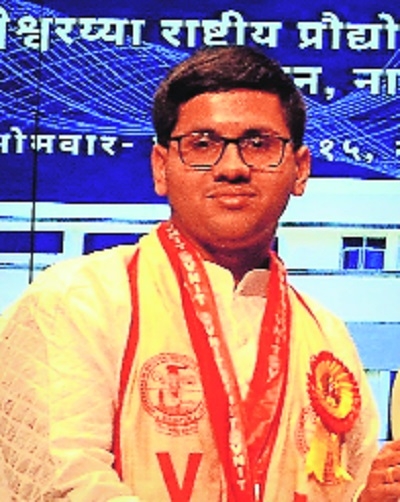
Institute’s strong focus on practical learning helped Siddhesh to excel
Siddhesh Vinay Shenoy, a graduate in Electronics and Communication Engineering, received the prestigious Sir Visvesvaraya Medal for securing the highest Cumulative Grade Point Average (CGPA) 9.68 across all disciplines of Bachelor of Technology in VNIT.
Siddhesh had initially enrolled in Electrical and Electronics Engineering but later shifted to Electronics and Communication Engineering based on his high CGPA. Reflecting on his journey, Siddhesh said the first year being completely online due to COVID-19 was challenging, but his academic performance improved once offline classes began. He appreciated the institute’s curriculum for its strong focus on practical learning, citing projects like developing a pulse sensor as key experiences that enhanced his understanding.
Siddhesh also pursued coding through online platforms and other courses, which helped him secure an internship that eventually turned into a job offer from a multinational company. He described receiving the medal as a profound honour, attributing his success to the combined support of his family, professors and peers.
Advising fellow students, he urged them to believe in themselves, make consistent efforts, explore beyond their fields, embrace technology, stay positive and extend help to others.