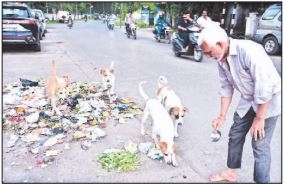
Street dog feeding in public places continues
| Date :15-Jan-2026 |
By Dhanendra Chaurasia :
THE Supreme Court’s latest and
stern observation on growing
menace of stray dogs have once
again brought civic accountability into sharp focus, particularly in cities like Jabalpur, where
the problem has persisted for
years with little visible intervention by the municipal
authorities. The apex court
made it clear that responsibility does not rest with governments alone.
Individuals and
organisations feeding stray dogs
in public places can also be held
accountable. The court warned
that heavy fines and compensation would be imposed for
every dog bite incident and
death if the State administration
fails to put effective preventive
mechanisms in place.
These fresh directions have
special relevance for Jabalpur.
A few months ago, the
Supreme Court had asked civic
bodies to identify and develop
designated feeding zones for
street dogs so that feeding in
public places, residential
colonies and busy roads could
be regulated. However, the
Jabalpur Municipal Corporation
(JMC) has barely moved beyond
paperwork.
No dedicated feeding zones have been developed,
nor has any public awareness
campaign been launched to
implement the court’s earlier
directions.
As a result, the city continues
to grapple with frequent dog
bite incidents, growing fear
among residents and repeated
clashes between dog feeders
and citizens. Children, elderly
people and morning walkers
remain the most vulnerable.
Despite the same, JMC’s
response has largely been reactive rather than preventive.
The Supreme Court, during
the latest hearing, observed that
failure in proper implementation of the Animal Birth Control
(ABC) Rules has worsened the
situation nationwide.
It underlined that compassion cannot
be selective and questioned why
emotions are shown only for
animals, while human safety is
often ignored. The court also
made it clear that if someone
feeds a stray dog, the animal
should be kept under supervision, licensed and treated as a
pet, not left free to roam and
attack people. In Jabalpur, the ground reality stands in sharp contrast to
these observations. ABC programmes have remained
patchy, data on sterilisation
and vaccination is rarely
shared publicly and there is no
clear accountability when
aggressive dogs are reported.
In Jabalpur, victims of dog bites
often find themselves running
from hospitals to police stations, with no clarity on liability or compensation.
What is missing in
Sanskardhani is political will,
administrative urgency and a
structured action plan. With
the apex court now warning
of penalties and accountability for both authorities and
feeders, pressure is mounting
on JMC to act. Designated
feeding zones, transparent
ABC implementation, strict
action against unsafe feeding
in public places and protection of citizens are no longer
optional.
Unless the Municipal
Corporation shifts quickly
from indifference to decisive
action, the stray dog problem
in Jabalpur will continue to
linger without solutions. Issues
will keep getting discussed,
but ground-level results will
remain missing.
Meanwhile, general public
will continue to pay the price
in fear, injuries and compromised public safety.