Nagpur Metro ridership misses DPR target by 3 lakh passengers
| Date :21-Jan-2026 |
By Simran Shrivastava :
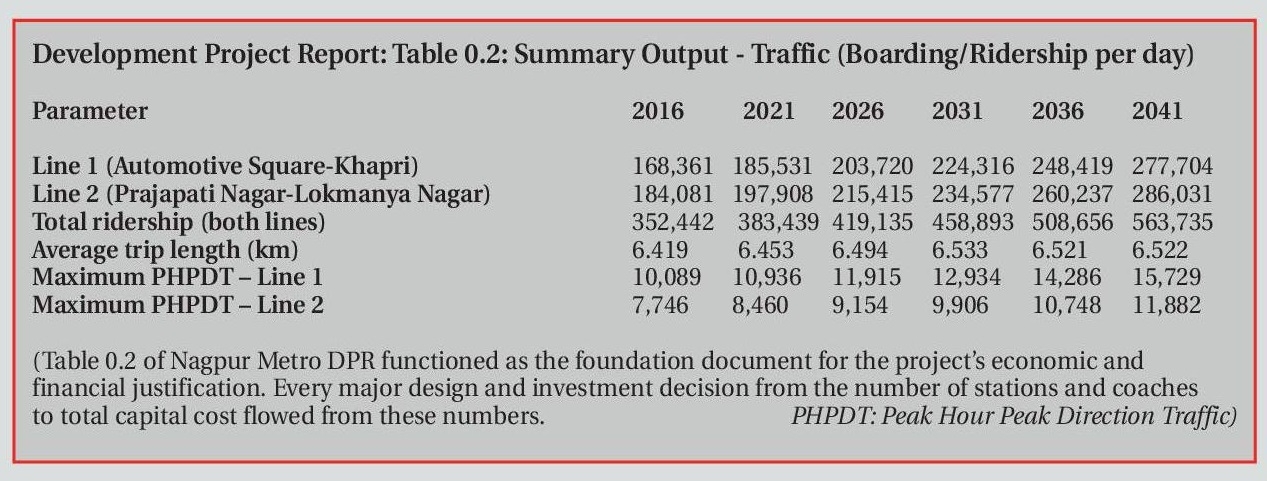
Ridership projections set down in the Detailed Project Report (DPR) of Nagpur Metro Rail Project have overshot actual numbers by more than 300 per cent. The actual daily ridership is 1 lakh, while the DPR had projected it to be 4 lakh by year 2026. This difference has brought a split between promise and performance when viewed through the lens of inflated forecasts, fragile finances and an enduring burden on public funds.
The DPR, prepared in November 2013, envisioned a metro network carrying close to 4 lakh passengers every day by 2026. That vision has not materialised. Recent passenger data reveals that daily ridership oscillates between 70,000 and 1.2 lakh, varying based on weekday patterns, weekends, and seasonal variations. This is a heavy departure from the numbers that under-pinned approvals, funding decisions and infrastructure design.
These projections formed the intellectual and financial backbone of the project. It shaped the economic viability, revenue modelling, rolling stock requirements and long-term capacity planning.
In a nutshell, these numbers were used to justify heavy capital investment, high-capacity infrastructure and dense peak-hour service schedules. This divergence brings forth questions on the forecasting discipline applied at the planning stage.
The DPR itself talks about the centrality of these estimates. It states that traffic studies and ridership assessment were first and most critical tasks in finalising alignments and station locations. Daily and peak-hour boarding and alighting figures were treated as foundational inputs for revenue estimation, benefit-cost analysis and the computation of economic and financial internal rates of return. When such assumptions falter, the entire financial architecture is placed under strain.
That strain is now unmistakable. With daily ridership at roughly one lakh, the system is operating at only a quarter of the demand projected for 2026.
The financial implications are substantial and enduring. Nagpur Metro Phase 1 was approved at Rs 8,680 crore, later revised to approximately Rs 9,279 crore after cost escalation, additional works and associated expenditures. These investments were rationalised on the strength of projected ridership and fare revenue. Lower passenger volumes now mean weaker fare box collections, which widens the gap between operating costs and income.
Although Maha Metro has cultivated some non-fare revenue through advertising, property development and station-level commercial activity, fare revenue remains inseparably tied to the passenger numbers. With ridership far below projections, fare income falls dramatically short of what the DPR envisaged, which leaves the system dependent on Government support for routine operations and debt servicing.
A senior metro official shared that the foremost challenge facing the Nagpur Metro has been behavioural rather than infrastructural. He said changing commuter mindsets remains difficult, as many residents continue to rely on personal vehicles and are hesitant to shift to a new mode of urban travel.
Despite this, he maintained that sustained efforts are being made to ease the transition.
The official said the metro has focused on closing critical connectivity gaps by strengthening first and last-mile access, introducing shared auto-rickshaw services and improving service reliability by bringing train frequency to ten minutes. These measures, he said, are aimed at making the metro a more convenient and dependable daily option for commuters. He added that while change takes time, the impact of these initiatives is gradually becoming visible, with ridership trends showing steady improvement.
However, critics argue that sustained operating losses will ultimately be absorbed by public purse, either through direct subsidies or indirect fiscal support, effectively transferring the cost of optimistic planning assumptions onto taxpayers.
With theories floating around that Government funding to operations might dwindle down over next few years, the question arises, as to who would then foot the bill? In the end, the general citizens might end up footing the hefty debt bill, or metro might need to further jack-up fare to optimise the revenue generation.