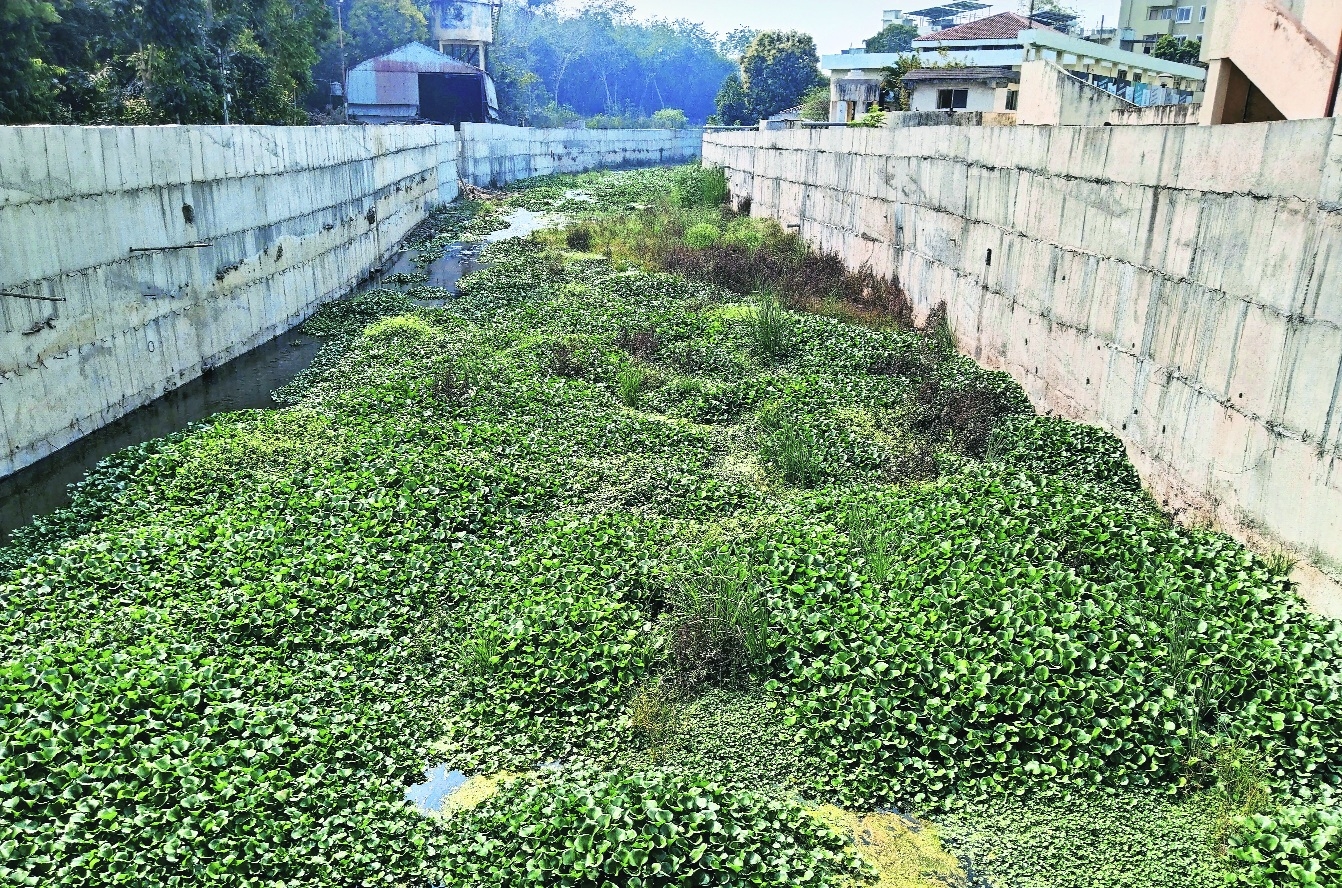
Eichhornia chokes Naag river while administration watches from the banks
| Date :26-Jan-2026 |
By Shashwat Bhuskute :
The Naag river has spent decades begging for dignity, but the administration seems determined to keep it throttled under layers of sewage, debris and now, a fast-spreading mat of Eichhornia. From Ambazari lake to its confluence with the Pili Nadi, the river resembles a forgotten drain rather than a central artery of Nagpur. This is not a natural disaster. It is a policy-induced collapse, enabled by public indifference and bureaucratic inertia.
The nightmare of September 23 2023, when half of Nagpur went under water, should have forced introspection. Instead, the civic body shrugged, offered another round of surveys, and abandoned Daga Layout to the same broken embankments that triggered devastation in the first place.
Despite repeated directives from the Prime Minister in 2022 to rejuvenate or at least clean the river, the Nagpur Municipal Corporation (NMC) has done little beyond paperwork. Twenty years of announcements about tendering and “upcoming projects” have produced no real action. Even today, the tender process exists only in future tense. Meanwhile, the Naag river continues to swallow sewage, leftover food, industrial effluents and construction debris, becoming an open-air catalogue of every civic failure imaginable.The Eichhornia explosion was inevitable. A river fed almost entirely by nutrient-rich sewage is an open invitation for water hyacinth to flourish. Environmental expert Kaustav Chatterjee had previously noted in ‘The Hitavada’ article its alarming spread across Shankar Nagar, Yashwant Stadium, Ghat Road, Jagnade Square and Hiwri Nagar. The weed blocks sunlight, depletes oxygen and suffocates aquatic life, but its
unchecked advance mainly proves one point: no one is actually monitoring the river.
Even the Municipal Commissioner previously had admitted to ‘The Hitavada’ he did not know the weed had spread deep into East Nagpur. The administration has now scrambled to consult NEERI and other institutions, but with Ambazari lake already crippled by Eichhornia and the Wadi STP only 60% complete after a year, there is little comfort in these manoeuvres. The Naag River Pollution Abatement Project, backed by over Rs 1,100 crore from the Centre and lofty timelines of 88 months, remains trapped at the starting line. Without sewer networks completed, without enforcement on dumping, and without basic riverbank protection, the Naag continues to be treated as a giant bin with water in it.
Nagpur asked for a clean river. What it received is a floating carpet of weeds, broken promises and a governance model in which crisis must drown the city before action even appears on the agenda.