‘VB-G RAM G is better than MNREGA’
| Date :06-Jan-2026 |
Staff Reporter :
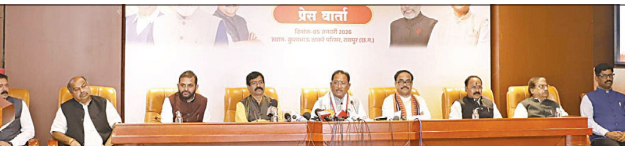
CHIEF Minister Vishnu Deo Sai
on Monday briefed the media
about the newly introduced Viksit
Bharat Guarantee for Rozgar and
Ajeevika Mission (Gramin) Act or
VB-G Ram G Act, stating that the
legislation reflects Prime Minister
Narendra Modi’s commitment
to the welfare of the poor, farmers and labourers.
Addressing a press conference,
the Chief Minister said the new
act has been designed to
strengthen villages, improve rural
livelihoods and bring greater
accountability to employment related schemes.
Vishnu Deo Sai
recalled that when Narendra
Modi first became prime
minister, he had pledged to dedicate his work to the upliftment
of the poor.
He said the impact of that
resolve was visible during the
first tenure, when major initiatives such as electricity connections, bank accounts, toilets and
housing were provided to large
sections of the population.
According to him, the new
act continues the same approach
with a sharper focus on labour
welfare.
The chief minister said the VBG Ram G Act is superior to the
existing MNREGA framework in
several aspects.
Under the new
act, the number of guaranteed
workdays has been increased
from 100 to 125 days. He said
labour payments will be ensured
within a week, and if there is any
delay, workers will be entitled to
interest. This provision, he added,
will protect labourers from payment-related hardships.
Explaining the need for
reforms, Vishnu Deo Sai said
Chhattisgarh and the country as
a whole are agriculture-dominated. He noted that MNREGA
works often clash with agricultural activities, especially during
harvesting seasons.
Under the
new framework, work can be
paused for up to 60 days during harvesting, which will ease pressure on farmers and reduce
labour shortages in agriculture. He said the changes would
also help curb migration to cities. The chief minister said
the act will reduce excessive dependence on machines by
encouraging the use of labour, leading to greater employment generation in rural areas. He described the initiative
as a potential revolution for villages, stating that it will
strengthen water conservation, ensure water security and
help build durable rural infrastructure.
He added that the
act will also help address damage caused to people during
floods. According to Vishnu Deo Sai, allied sectors such as
cattle rearing, fisheries and poultry will receive a boost under
the new framework. He said Krishi Gati Shakti will be given priority, while administrative expenses have been
increased from 6 percent to 9 percent to ensure better
implementation and remuneration. Women self-help groups
will also benefit, contributing to self-reliance and a stronger
rural economy.
He said gram sabhas will play a key role in deciding the
priority of works, especially in areas related to water conservation. Responding to opposition protests, the CM said
the objections were largely symbolic. He rejected claims
that the name of Mahatma Gandhi was being removed,
arguing that many institutions across the country continue to bear the names of leaders from the Gandhi-Nehru
family.
He alleged that the Congress itself had ignored Mahatma
Gandhi’s call to dissolve the party.
Vishnu Deo Sai said the
new act would help curb irregularities and bring greater
accountability. Citing the union ministry of rural development, he said more than 10.51 lakh complaints had been
received earlier, highlighting the need for reform. He
acknowledged that the financial burden may increase but
maintained that benefits, transparency and accountability brought by the act would outweigh the costs and lead to
long-term strengthening of villages.