INFRA PUSH: Cabinet approves over Rs 30,000 cr
| Date :07-Jan-2026 |
Staff Reporter:
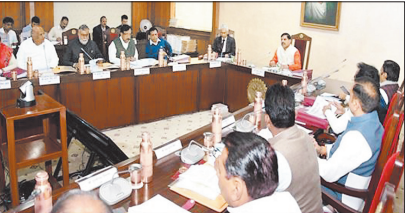
THE Cabinet, chaired by Chief
Minister Dr Mohan Yadav, on
Tuesday, approved a series of
major development projects
aimed at boosting irrigation,
rural road connectivity, and overall infrastructure in the state.
The Cabinet meeting, held at the
Mantralaya in Bhopal, also
included the rollout of the eCabinet system, with ministers
and officials provided tablets
and trained to use the platform
for improved governance.
But before the start of the
Cabinet meeting, Chief Minister
Dr Mohan Yadav addressed ministers, highlighting the
Government’s priorities, achievements of the past fortnight, and
key goals for the next three years.
He congratulated the ministers
on the start of 2026 and emphasised Madhya Pradesh’s role in
national development. Dr Yadav
highlighted the State’s emergence
as a leader in the mining sector,
with 32 out of 141 mineral blocks
auctioned nationwide in 2025,
boosting industries like cement,
steel, and bauxite.
He also recounted the
Abhyuday Madhya Pradesh
Growth Summit in Gwalior, where
over Rs 2 lakh crore in industrial
and infrastructure projects were
launched, alongside incentives
for 860 major units.
The Chief
Minister noted that 2026 is being
celebrated as the “Agriculture
Year”, with plans for farmer welfare, horticulture, food processing, and rural development.
In the Cabinet meeting, a key
highlight was the approval of
over Rs 2,598 crore for irrigation
projects in Burhanpur district,
which are expected to benefit
tens of thousands of farmers.
The Jhirmiti Medium
Irrigation Project in Khaknar
tehsil, costing Rs 922.91 crore,
will provide irrigation to 17,700
hectares of land across 42 villages, supporting about 11,800
farming families.
Another major project, the
Navatha Major Irrigation Project
in Nepanagar tehsil, with a cost
of Rs 1,676.06 crore, will irrigate
34,100 hectares across 90 villages, benefiting around 22,600
families.
These projects aim to
improve agricultural productivity and ensure water availability in critical farming regions.
The Cabinet also approved the
continuation of the PM Janman
Scheme under the Madhya
Pradesh Rural Road Development
Authority. The scheme, which
runs from April 2026 to March
2028, has an estimated expenditure of Rs 795.45 crore. Under this
program, a total of 1,039 km of
roads and 112 bridges will be constructed across 22 districts, focusing on improving connectivity for the Baiga, Bhariya, and Sahariya
tribal communities. The continuation of the scheme is
expected to enhance access
to education, healthcare, and
markets for these remote tribal
populations.
In addition, the cabinet
approved the extension of the
Pradhan Mantri Gram Sadak
Yojana (PMGSY) from April
2026 to March 2031, with an
estimated outlay of Rs
17,196.21 crore. This phase will
involve the construction of
20,000 km of rural roads and
1,200 new bridges across the
State. The Government also
sanctioned Rs 10,196.42 crore
for the renovation and upgradation of existing rural roads
under the PMGSY scheme.
This will cover 88,517 km
of roads, ensuring smoother
travel, better transport of
goods, and improved access to
remote villages.
To ensure rapid implementation of irrigation projects, the
Cabinet approved funding
through the Narmada Basin
Projects Company Limited.
Under this arrangement,
Ongoing projects initiated by
the Narmada Valley
Development Authority will be
completed with financial support from the company, which
will hold full ownership of the
completed works.
The State Government will
transfer equity shares to the
company equivalent to the
budgetary expenditure made
on these projects.
Currently,
two major projects are being
financed through this method:
the Narmada-Kshipra
Multipurpose Project, costing
Rs 2,489.65 crore, and the
Badanwar Micro Lift Irrigation
Project, costing Rs 1,520.92
crore. Once completed, the revenue generated from these
projects will be received as
company income, creating a
sustainable model for future
development.
The Cabinet also emphasised
transparency and technology-driven governance, providing
tablets to ministers and officials
and training them for the eCabinet system, which aims to
streamline decision-making
and reduce paperwork.