Panchdeep Nagar: Where civic disorder is order
| Date :07-Jan-2026 |
By Simran Shrivastava :
The residential-access corridor has gradually been overtaken by an unauthorised ‘chowpatty’ and a cluster of food trucks, which operate daily with remarkable regularity and little apparent oversight
The stretch abutting the Narendra Nagar flyover has, over the past several months, slipped into a state of persistent civic disorder, which has drawn concern from residents of Panchdeep Nagar and adjoining localities. The residential-access corridor has gradually been overtaken by an unauthorised ‘chowpatty’ and a cluster of food trucks, which operate daily with remarkable regularity and little apparent oversight.
The informal set-up comes alive each evening and continues late into the night.
This has converted the area into a congested, noisy, and unruly zone well beyond acceptable hours for a residential neighbourhood. Traffic movement slows, pedestrian access is compromised, and the character of the locality shifts sharply after dusk. Several residents have pointed to the brazenness with which objections are dismissed. Nilanjan Banerjee, a long-time resident of the area, claimed that when locals raise concerns, they are often told by local authorities that no action will be taken.
The response of the local municipal machinery has further fuelled disquiet. Complaints, Banerjee alleges, are routinely met with requests to ‘adjust’. “Adding to the unease is an under-construction chowpatty project being developed by the Nagpur Municipal Corporation (NMC) itself, a structure that has remained incomplete for nearly two years,” Banerjee said. Residents fear that once operational, it will legitimise and permanently entrench the very problems currently faced in an unauthorised form.
Police presence and civic action reportedly intensify only during high-profile events or visits by influential individuals to a nearby Cabinet Minister’s residence, restoring order briefly before the area reverts to its previous state.
The social impact on the ground has been severe. The area has increasingly become a site of open drinking, public urination, and indiscriminate garbage dumping. Residents recount frequent verbal abuse when they object to such behaviour. Banerjee recalled instances where locals were subjected to crude and aggressive language, questioning their right to object within their own colony.
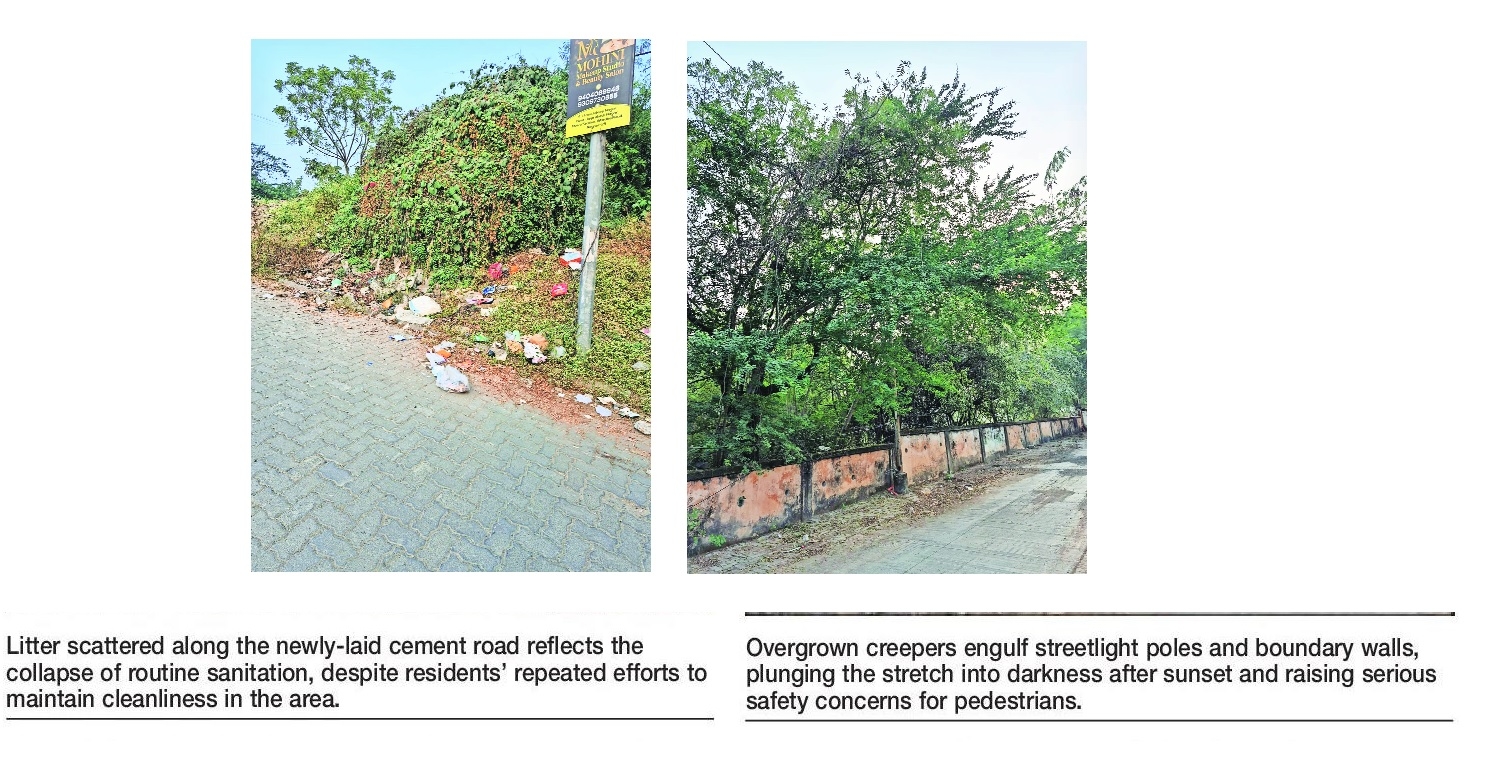
Despite recent infrastructure upgrades, including the construction of a cement concrete road, the sense of security has not improved. Streetlights along the stretch are heavily obscured by overgrown creepers, plunging the lane into darkness after sunset. Residents say the road may be new, but the environment feels increasingly shady and hostile once evening sets in. Sanitation remains another flashpoint. Civic officials have reportedly cited a shortage of sanitary workers, resulting in cleaning being carried out only once or twice a week. While residents attempt to maintain cleanliness themselves, the scale of misuse and littering quickly overwhelms these efforts.
When questioned regarding the same, an NMC official said that the responsibility of people creating nuisance does not lie within the corporation, and that, police needs to be contacted regarding the same.
Banerjee noted that individual responsibility cannot compensate for systemic neglect and unchecked misuse of public space. The cumulative effect of noise, filth, intimidation, and administrative inertia has pushed residents to a point of exhaustion. Many describe a growing sense of abandonment and uncertainty, with patience wearing thin and faith in institutions steadily eroding.