South African jurist of Indian origin Navi Pillay wins Nobel Peace Prize
| Date :10-Oct-2026 |
OSLO :
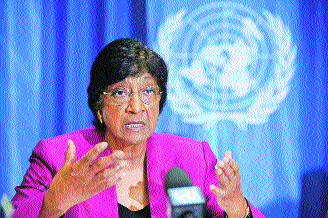
SOUTH African jurist of Indian origin Navanethem “Navi” Pillay, a former UN human rights chief whose work helped shape international law on genocide and sexual violence, won the 2026 Nobel Peace
Prize on Friday for her efforts to promote peace and international law.
She is also serving as a judge in a case at the International Court of Justice in which The Gambia has accused Myanmar of violating the Genocide Convention. Born in Durban on September 23, 1941, to Indian parents of Tamil descent, Pillay grew up under apartheid and went on to build a career challenging racial discrimination, defending anti-apartheid activists and advancing human rights and equality.
According to a biographical profile published by the Institute for African Women in Law, Pillay’s father was a bus driver who worked multiple jobs to support the family, while her mother looked after their eight children. Despite financial hardship, her parents placed a strong emphasis on education and insisted that their daughters, like their sons, should be educated.
Pillay studied at the University of Natal and later earned postgraduate law degrees from Harvard University. In 1967, she became the first woman of colour to establish a law practice in South Africa’s Natal Province, according to the Institute for African Women in Law.
She spent decades defending anti-apartheid activists and highlighting the treatment of political detainees.
In 1973, she helped secure the right of political prisoners to access legal counsel, according to South African History Online.
She also represented anti-apartheid activists and drew attention to the use of torture and solitary confinement against detainees.
Pillay was involved in efforts to enshrine equality in South Africa’s Constitution. As a member of the Women’s National Coalition, she contributed to the campaign that helped secure a constitutional equality clause prohibiting discrimination. In an interview with South African History Online, she described how women from different political, racial and religious backgrounds worked together to advance equality and protect women’s rights.
Her career later took her to South Africa’s High Court, the International Criminal Tribunal for Rwanda and the International Criminal Court. She served as a judge and president of the Rwanda tribunal and as the UN High Commissioner for Human Rights from 2008 to 2014.