Paper-safe 58% water stock in reservoirs masks acute crisis
Date :12-Oct-2026
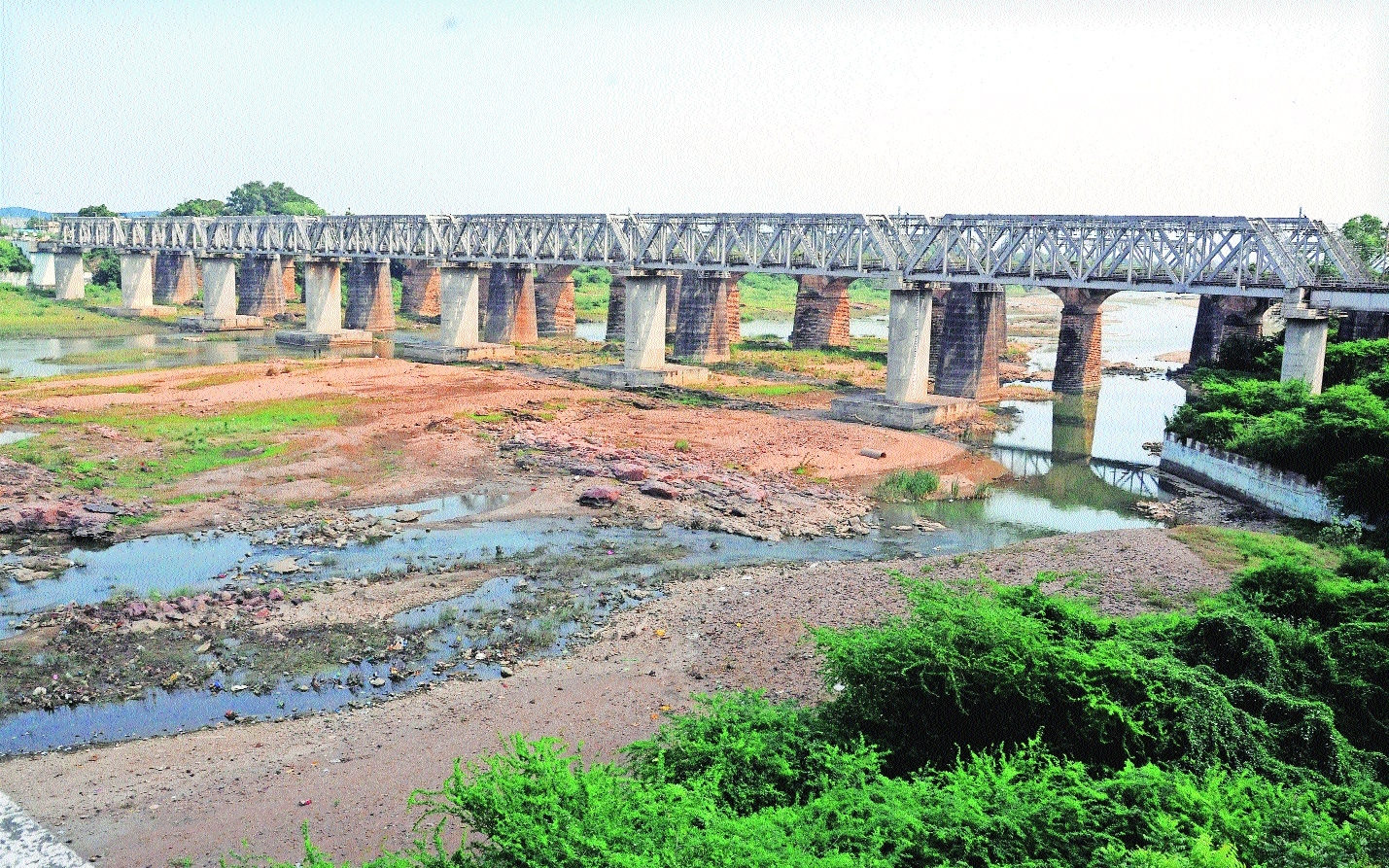
Parched Kanhan river indicates a grim situation in the near future.
Staff Reporter :
Extended El Nino threat looms over city
On paper, Nagpur appears cushioned against immediate distress. The city’s reservoir network records an aggregate reserve of 746 million cubic metres (MCM) around 58 per cent combined storage, theoretically calculated to sustain municipal drinking needs until mid-2027.
Yet, beneath this mathematical comfort lies a looming crisis, as it may disrupt the winter also after playing spoilsport with rainy season. With meteorological projections indicating an extension of El Nino weather patterns until February 2027, soaring post-monsoon heat and rapid evaporation losses threaten to quickly decimate that buffer, casting a long shadow of scarcity over the city. During winter, the demand for water drops but going by current temperature range, the October heat is proving too strong for people. Already coolers at most homes has restarted which would increase the demand for water.
Coupled with it, the intense heat might increase evaporation losses, so the authorities need to tighten its belt to pull it over till the next monsoon cycle.
Compounding these structural worries is the Maharashtra Government’s directive enforcing a mandatory 10 per cent cut on urban local bodies starting October 16. Spurred by an erratic monsoon and El Nino impact, the order mandates water cuts until August 31, 2027. If applied proportionately to Nagpur’s daily demand of 740 million litres per day (MLD), the city stands to lose roughly 74 MLD, reducing availability to 666 MLD and leaving zero operational margin.
The most acute concern centres on Totladoh reservoir, the linchpin of the Pench network that supplies 520 MLD of the city’s 740 MLD quota, while Kanhan supplies 220 MLD.
According to Water Resources Department (WRD) data from October 7, Totladoh’s live storage has plunged to a four-year low of 49.85 per cent (506.99 MCM) less than half the 99.92 per cent recorded in 2025. Other reservoirs exhibit similar distress: Kamthi-Khairi has fallen to 78.16 per cent (from 98.43 per cent), Khindsi to 66.17 per cent (from 100 per cent), Nand to 84.54 per cent (from 100 per cent), and Wadgaon to 58.98 per cent (from 100 per cent). This sharp depletion evokes grim memories of January 2019, when Totladoh plummeted below 10 per cent (101.63 MCM), triggering civic alarms, imperiling the Koradi and Khaparkheda power plants, and forcing emergency inter-state negotiations with Madhya Pradesh for water releases from the Chaurai dam.
NMC Water Works Committee Chairperson Divya Dhurde stated that while 746 MCM provides a baseline until mid-2027, summer-like temperature and rapid evaporation could pose major hurdle. To protect potable stocks, the civic body is surveying 580 traditional wells to fit solar pumps and hydrants, while mandating STP-treated water for civil works and gardens. Compounding this anxiety are persistent operational failures. An October 6 shutdown on the 1,400 mm Pench-IV feeder overshot its 36-hour schedule to stretch past 60 hours, drying up taps across 20 command areas. With NMC and Orange City Water (OCW) scheduling another 24-hour shutdown from 6 am on October 13 to 6 am on October 14 for leak repairs, citizens face recurring disruptions amid a looming structural drought.