Tepid take
| Date :17-Oct-2026 |
By Pavi Vyas :
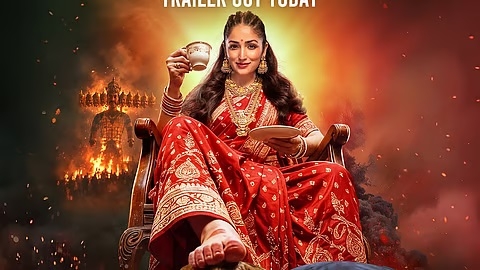
A women-centric supernatural horror comedy in a quirky Indian family setup? It is not the first of its kind in Bollywood. But Nayyi Navelli begins with a premise that immediately hooks the audience with its well-timed punches, a landing supernatural element, and a strong central theme knitted with social commentary.
The Yami Gautam Dhar-led engaging entertainer attempts to blend fantasy, comedy, horror, and Hindu mythology with a story about a newlywed bride who seems too good to be true in her marital home. Suspicion grows, and a shocking truth unfolds - the son of this family is married to a ‘Daayan’ (witch)!
The story unfolds in Meerut’s middle-class Awasthi household, where Gautam’s character, Mohini, enters, marrying the son Raja, played by Chandramukhi (2022) fame Addinath M. Kothare. Loved by all, Mohini is empowered, smart-witted, and an all-rounder. However, her brother-in-law Bantu, played by brilliant Anurag Thakur, starts spying on the seemingly ideal Mohini, only to discover the truth that Mohini might be a Daayan.
This gives the film its entertaining ‘Daayan-Bhabhi’ trope, which has the audience rolling with laughter. It also opens the door for the premise to explore the ways empowered women are perceived within Indian traditional family structures.
The first half of the film indeed chose its way in underscoring the persisting societal evils and blemishes with comedy wrapped in supernatural horror. The social commentary, from “bahu mein khot, bete ki khaamiyaa dekhne se aasan hota hai”, to Mohini unfolding the truth to the family about how the true evil is not a woman who is empowered, but the men who bad-touch, bad-mouth, or raise their hand on a woman. The film conveys its message with Hindu mythological references, comparing a man who respects women to ‘Maryada Purushottam’ (An epithet for Lord Ram) and with the supernatural fighting sequence that seemingly felt like a reimagining of the battle between Mahishasur and Maa Durga.
The film, in its first half, seems to be conveying the underlying message of taking inspiration from our mythological stories to identify social evils, as well as to become a better human and grow emotionally. However, as the film’s narrative proceeds to the second half, the writing falls apart, leaving the plot confused about its own direction. The film suddenly turns too preachy and erases the thin line between taking inspiration from mythological stories and blindly believing in mythological stories as the ultimate truth.
The second half glorifies divine God figures and stretches the climax too long, making it unbearably unrealistic for the audience, while the ending with the ancient age-old idea of ‘man saviour’ is particularly annoying, losing the audience’s interest and making them roll their eyes. While the film had a lot of potential with its central theme, despite its clichéd Bollywood horror setup, the film became a victim of its ambitious writing, which felt scattered and confused.
However, the film’s attempted comic relief landed well, steered by Anurag Thakur and Pratik Pachori (playing Pannu Chacha) alone. The brilliant choice of animation in retelling the mythological epic felt impressive as well. The strong and refreshing faces of the entire cast really did a lot for the film, saving the badly falling-apart plot.
The much-anticipated directorial debut of Balaji Mohan (you might know him from Dhanush-starrer Maari) felt underwhelming. While the film’s action sequence, VFX, cinematography, and music also failed to elevate the film’s experience as well.
Overall, the film deserves its due credit for attempting something beyond the conventional Bollywood formula, but fell victim to scattered storytelling and disturbed pacing of the film. Despite the entertaining moments and a gripping plot in the first half, Nayyi Navelli fails to be called even a one-time watch.
The Hitavada Rating: OO