Awareness without shame
| Date :18-Oct-2026 |
By Sakshi Dhopade ;
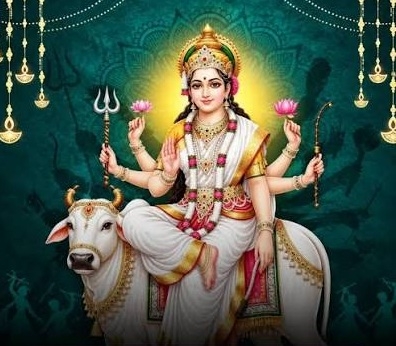
Today comes the eighth day of Navratri and we
worship Maa Mahagauri on this day. Her name means extremely fair and radiant.
She rides a white bull and carries a trident and damru, symbolising purity and peace. Devotees offer her coconut and pray for relief from suffering and the
fulfilment of their wishes.
ACROSS many societies and cultures there stands a contrast between the worship of the divine and the stigma surrounding women’s body. Females are treated as the sacred vessel of creation of life and power yet, the biological reality of the same is treated as unclean, shameful and a taboo.
Guwahati celebrates its Ambu Bachi Festival, celebrating the yearly menstrual cycle of Goddess Kamakhya. It is believed that, Maa Kamakhya, whose sacred presence takes a form of a naturally yoni-shaped rock fed by an underground spring, undergoes her annual menstruation during this period. During this time, the temple closes for three days for ritual seclusion, and reopens with grand ceremonies and sacred prasad.
But why is menstruation celebrated as a grand festival for the goddess and as a period of untouchability, social exclusion and shameful?
The myths revolving around menstrual impurity often creates a rigid boundary that restricts women’s life particularly during the sacred period of Navratri. Breaking this cycle of forced exclusion needs confronting the roots of the problem, because menstruation is rarely discussed openly and accurately and hence the myths pass from one generation to another unchallenged.
Menstruation is the natural biological process, where the uterus of the woman sheds the uterine lining every month on non-occurrence of pregnancy. Without detailed, age-appropriate sex education, young people remain highly vulnerable to harmful myths. The lack of knowledge brings along deep confusion, misinformation about puberty, reproductive health, critical concepts of consent and basic bodily autonomy.
In return, the consequences of this silence not only affect the woman’s emotions but also her health, dignity and here mere survival.
Menstruation, pregnancy and breastfeeding are natural aspects of human biology, not reasons to isolate, humiliate or discriminate against women. Recognising the uniqueness of a woman’s body must begin with understanding its science, respecting its needs and protecting every woman’s right to make informed decisions about her own health.
Beyond the basic understanding of menstruation, young people must also be educated about the menstrual cycle, ovulation and reproductive health. Scientific information is essential because, in the absence of reliable sex education, young people may depend on myths, peer advice or misleading information available online.
However, awareness alone cannot bring change unless it is followed by practical solutions. Schools and colleges must introduce age-appropriate, scientifically accurate sexuality education that explains puberty, menstrual hygiene, reproductive health, consent and bodily autonomy. Teachers should be trained to answer questions without judgement, while parents should be encouraged to create safe spaces where children can discuss their doubts openly.
Instead of treating menstruation as a reason for exclusion, communities must recognise it as a normal biological process that requires dignity, understanding and appropriate healthcare.
Comprehensive sexuality education is not a threat to Indian culture but an investment in human dignity. Families must replace shame with conversations; schools must replace myths with science and healthcare provides must protect informed
consent. This Navratri, the celebration of Shakti must translate into meaningful action.