Ghatasthapana A sacred tradition in Maharashtrian homes
| Date :18-Oct-2026 |
By Mohnish Giramkar
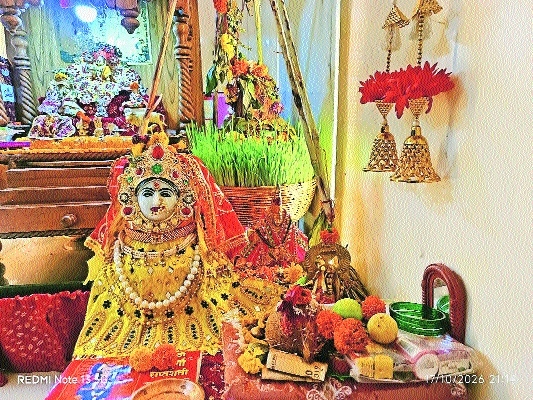
Navratri holds special significance for Maharashtrian people. Ghatasthapana is one of the most auspicious rituals in Marathi homes. Families set up a sacred pot and sow grains in an earthen vessel. A lamp is lit and prayers are offered every day for nine days.
On Pratipada, homes are cleaned and purified. On a sacred altar of clean soil, the Ghat is established as the symbol of the Universe holding all deities. Under it, nine grains including wheat, jowar, bajra and moong are sown. In nine days they sprout into green seedlings. In Vidarbha, this is not decoration, it is our link to farming and prosperity. At the centre burns the Akhand Jyoti. Behind the flame sits Tulja Bhavani, the Kuldevi of many Marathi families, in red veil, silver crown and garlands of jasmine and marigold. In front, the Ghat sits in a bamboo basket, decorated daily with marigold and rose. On it, a ghee lamp with mango leaves burns continuously from Pratipada till Vijayadashami. Family members take turns to keep the flame alive. Its light is believed to dispel darkness and keep a constant link with the Goddess.
Then comes the discipline of fasting. It is purification, not dieting. Many observe one sattvik meal after sunset. Others live on fruits, milk, sabudana khichdi, varai with peanut curry and rajgira puri. Onion, garlic and non-veg are avoided. Evenings are for Devi Saptashati path and ‘Durge Durgat Bhari’.
What makes Maharashtra distinct is the courtyard tradition.
In colonies of Mahal,
Dharampeth and Itwari,
women gather around the
image of an elephant symbol
of happiness to sing Hadga,
Bhondla and Bhulabai. While
singing, they worship the Ghat
as the Goddess. It is a tradition
passed from grandmother to
mother to daughter.
Between these nine days,
many households perform
Mahalakshmi sthapana. Two
idols of Mahalakshmi in rich
sarees with nath and traditional
jewellery are placed with child
idols, Ghat and fruits. Puja is
done with haldi-kumkum, oti
and naivedya.
For many families in Nagpur, these rituals are
deeply personal. It is believed
she brings wealth and blessings for daughters and daughters-in-law. “For nine days, we
keep the Ghat like our own
mother in the house. We take
turns for the Akhand Jyoti, we
do fasting and read Saptashati.
When we sing Bhondla together in the evening, it feels like
our culture is still alive in our
daughters,” said Nutan Mane
and Mayuri Sirsat, housewives
from Dharampeth.
This faith finds its collective
form at the city’s temples. Priest
of Bhavani Mata Temple,
Bajarang Nagar, Tukaram Naik
said, “At our temple, hundreds
of families register their Jyoti
during Navratri. At Koradi,
Agyaram Devi Temple at
Ganeshpeth and Annapurna
Temple, Bagadganj too, the
Jyoti burns day and night. On
Ashtami-Navami we perform
Kanya Pujan girls aged 2 to 10
are worshipped as Navdurga
with halwa-puri and oti. On
Vijayadashami, when the Ghat
is immersed with the chant of
‘Changabhal’, the flame may go
out, but its blessings stay in the
home for the whole year.”