Southern Legacy Rich tapestry of Navratri customs
| Date :19-Oct-2026 |
By Rohit Pawar :
From Tamil Golu displays and Kannada Bombe Habba heirloom dolls to Telugu festivities and Malayali prayers, South Indian families in Nagpur celebrate Navratri through traditions passed down for generations
Inside South Indian homes in Nagpur, Navratri unfolds through a rich tapestry of regional
customs. Dolls fill elaborate displays, heirlooms carry family histories, and prayers to the Goddess bring generations together in
celebrations rooted in ancestral traditions.
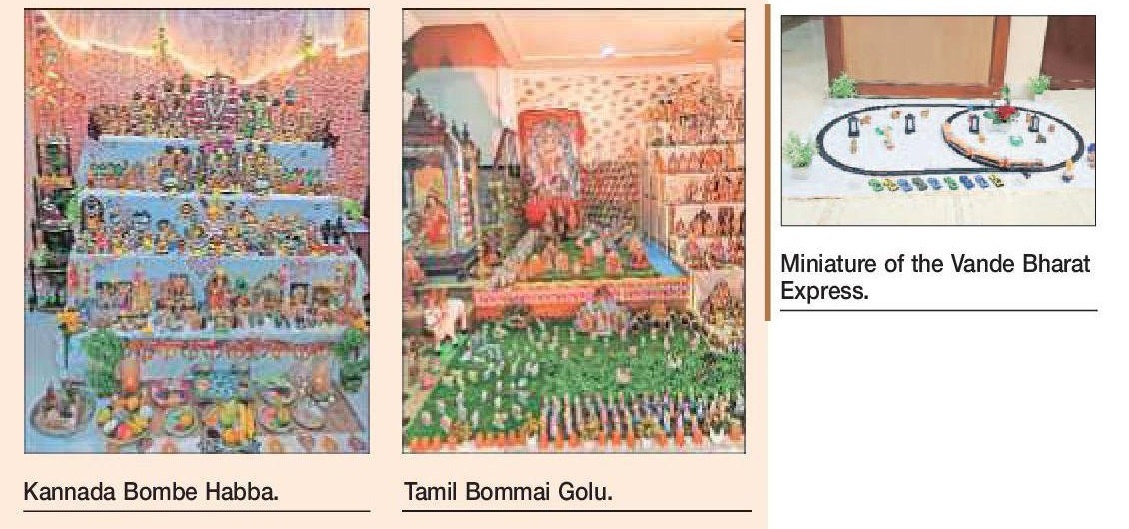
For Tamil families, ‘Bommai Golu’ is a cherished expression of this heritage. Pushpa Anand, a resident of Vasudeo Nagar and a retired school principal, has maintained the tradition for 35 years. “Bommai Golu translates as a festival of dolls,” she explained.
The figures are arranged on an odd number of steps. This year, her ‘Dev Bhumi’ display occupies nearly half her living room, bringing together representations of deities and sacred places, including Koradi Temple, Mahurgad, Tekdi Ka Raja and Ayodhya.
“The mud dolls have great significance and importance,” Anand said. She highlighted Marappachi Bommai, traditional red sandalwood dolls passed down as family heirlooms. Brides receive pairs from their parents and in-laws to carry into their new homes as aher. Anand also welcomes visitors for Haldi Kumkum throughout the ten days. She described a belief
that a couple whose first child is a daughter may begin Golu
immediately, considering the child a blessing of the Goddess.
The Iyer family from Aakar Nagar -- V Rajagopalan, Mahalakshmi Rajagopalan and Dr Sridhar Rajagopalan Iyer -- offers another glimpse into Tamil celebrations.
Their Golu tradition spans nearly 150 years and five generations. This year, their miniature display depicts the Vande Bharat Express journey from Delhi to Srinagar, blending an inherited tradition with a contemporary theme. For Govindaraj Bhatta, Surve Nagar resident, the Kannada tradition is equally rooted in family heritage. His family has maintained its ‘Bombe Habba’ in the traditional Mysuru style for 50 years. “I have seven pairs of these dolls passed down through generations,” he said, referring to figures made from red sandalwood and black wood.
Bhatta described Navratri as a major festival for Kannadigas, with Mysuru Dasara, associated with the Wadiyar dynasty, representing its grandest expression.
The seventh day is particularly important to his family for Saraswati Puja. Women observe fasts according to their traditions, while different sweets are offered as naivedya. On Dussehra, families exchange ‘Shami’ leaves, unlike Maharashtra’s custom of exchanging ‘Apta’ leaves.
For Telugu families, Navami and Dashami hold special significance, said P S N Murty, secretary of the Andhra Association and a resident of Pratap Nagar. “Navami and Dashami are the most important days during Navratri for us,” he said. Navami is dedicated to Goddess Durga, while Dashami brings new clothes, payasam, sweets and visiting guests. Murty also highlighted the importance of Makar Sankranti. “For us, Makar Sankranti is the biggest festival,” he said, adding that his community displays Golu during the Sankranti period in January. Unnikrishnan Nair, a Malayali resident of Ravi Nagar, described his family’s observance through learning and prayer. On Navami and Dashami, the family places study books before the home mandir and removes them after the Dashami rituals conclude.
These customs reflect the diversity of South Indian celebrations. In Nagpur, families continue to give their ancestral traditions a living presence, carrying them forward while making them part of the city’s shared cultural life.