Dr rajesh modi: Where technology meets healthcare
| Date :24-Oct-2026 |
By Aasawari Shenolikar :
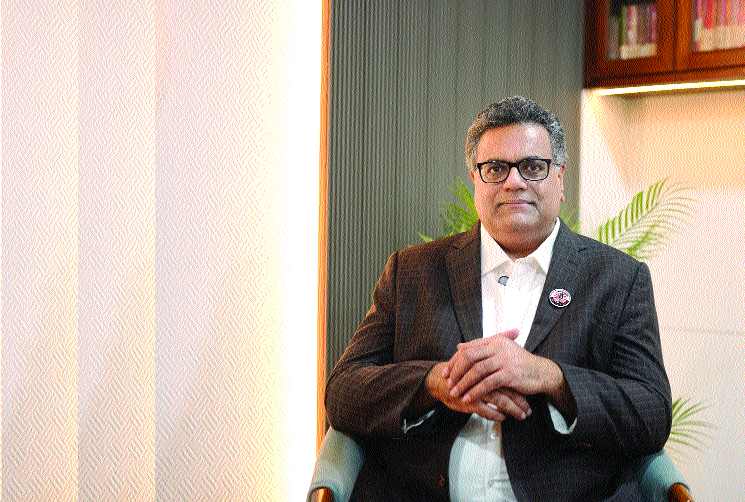
Technology has made inroads into every field, and medicine is no exception. Robots have entered operating theatres, AI is making its presence felt, and surgical procedures are becoming more precise by the day. But can technology ever replace the human brain? Not quite. That was the strong message that came through in The Hitavada’s The People's Mic - Health Decoded series featuring Dr Rajesh Modi, endoscopic surgeon and a known name in IVF, in conversation with Aasawari Shenolikar, Deputy Editor, The Hitavada.
Robotic surgery has certainly made life easier for surgeons. The precision it brings to a procedure is a huge advantage. But when it comes to taking
the final call, it is still the doctor who matters.
“Healthcare has changed significantly in the last couple of decades. Robotic surgery has become an important part of hospitals and clinics, making procedures more precise and refined,” says Dr Modi.
The shift from open surgery to laparoscopy, and now to robotic-assisted surgery, has been fairly swift.
Doctors have much to cheer about, but has the patient’s expectation changed all that much? “Not really,” asserts Dr Modi, “Whether it is open, laparoscopic or robotic surgery, all that the patient wants to hear is ‘Operation successful hua!’”
For the surgeon, though, the difference is considerable. Dr Modi welcomes robots into the operating theatre, but the thought of AI advancing to a stage where the doctor becomes redundant does worry him. Technology is welcome, he is of the firm opinion, as long as the doctor remains the decision-maker. “After all, a machine may assist in a procedure, but it is the doctor who has to weigh the options and take responsibility for the patient,” he states.
The conversation then moves to IVF, a subject that was once whispered about, if discussed at all. Thankfully, things are changing. Couples are more willing to seek help, families are
becoming more accepting, and men are no longer as reluctant to undergo evaluation and treatment as they once were.
Dr Modi is particularly happy that this change is slowly reaching the hinterlands, too.
But he has a word of caution for couples who keep putting off parenthood. When the elders at home ask, “Good news kab suna rahe ho?”, one may well roll one’s eyes. Yet, there is a practical point behind the question. “Fertility declines with age, and postponing the decision to have a child can sometimes make conception more difficult,” he states.
Dr Modi’s advice is simple, “if you are young and healthy, natural conception should be the first choice. Couples should understand their fertility health and seek advice when needed, rather than wait until they encounter difficulties. IVF is a valuable option, but timely awareness can make a difference.”
When the subject turns to day-care surgery, Dr Modi perks up. This is clearly a subject close to his heart. “For the last 25 years, I have admitted patients in the morning, operated on them by mid-morning, made them walk in the afternoon and discharged them by 5 pm,” he says, almost as if it were the most ordinary thing in the world.
But it isn’t such an ordinary thing, especially when one considers the apprehension that the word operation can trigger.
Ask a woman who has been advised surgery, and the first reaction could well be, “Zaroori hai kya? Postpone nahin kar sakte?”
The fear is not always of the operation itself. There is often another worry lurking in the background: who will look after the house if she has to stay in bed for days?
Whether she is a working woman or a homemaker, the thought of being away from her usual responsibilities can be daunting. And that is where day-care surgery has made a difference. The prospect of undergoing a procedure and returning home the same day makes the entire experience less intimidating, provided the procedure and the patient’s condition are suitable for it.
There is also the comfort of knowing that the doctor is only a phone call away.
“I find that these days patients after discharge, patients are more reassured. That is because they know that the doctor is one call away.” With WhatApp and video calls, day-care surgery has become more acceptable, although proper follow-up and medical supervision remain important.
From robots in the operating theatre to changing attitudes towards IVF and the growing acceptance of day-care surgery, Dr Rajesh Modi, now practising in Nagpur too at Dr Modi Pluro, a first of its kind, single facility robotic centre for women, touches upon issues that concern doctors and patients alike. His message throughout the conversation is clear: embrace the technology, welcome the convenience, but never forget the doctor behind the machine.
Catch the full conversation on The People’s Mic - Health Decoded, available on YouTube at @TheHitavada1911.n