In Pench’s buffer, women turn invasive weed into a livelihood opportunity
| Date :25-Oct-2026 |
By Sayli Watkar :
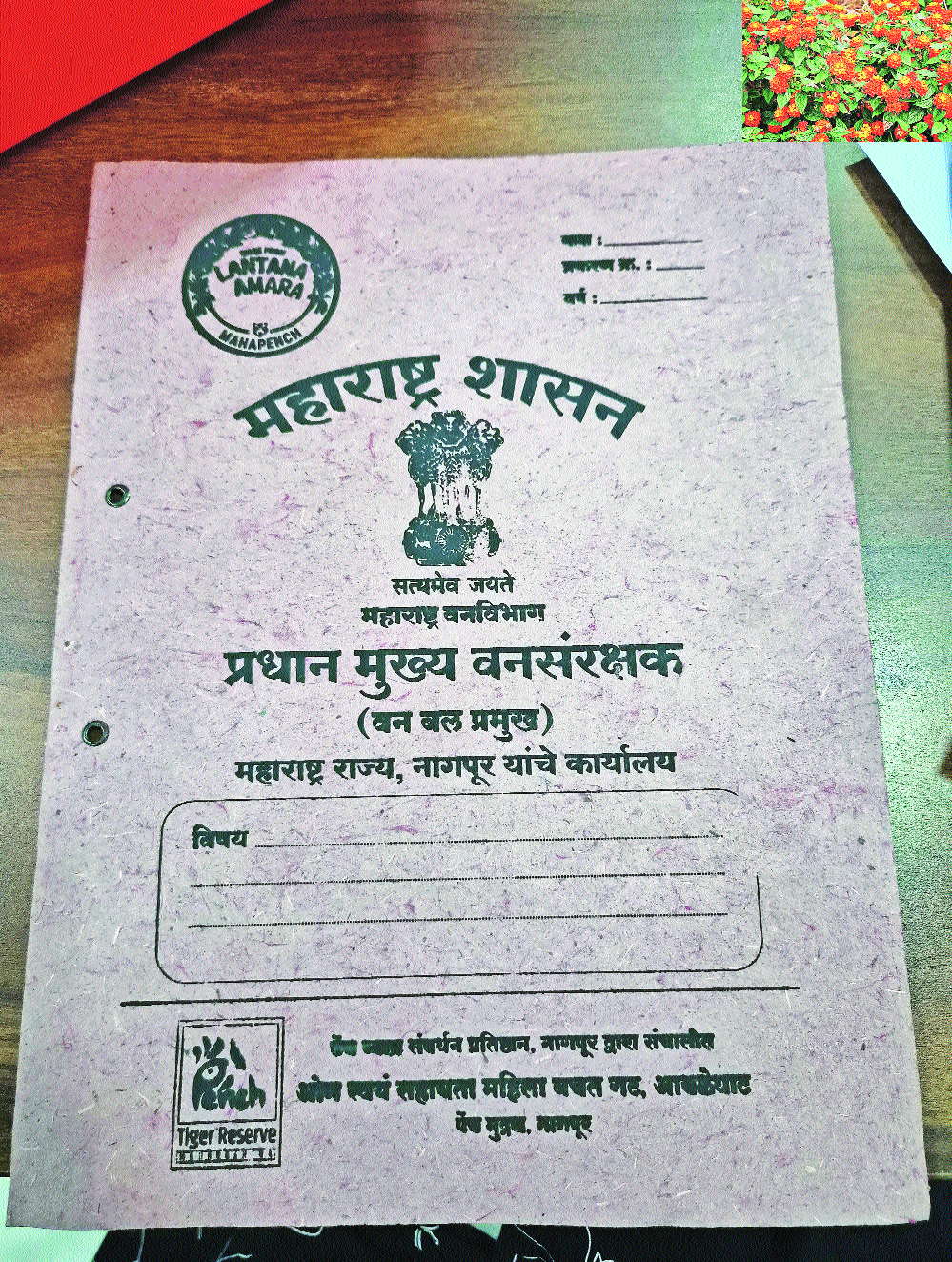
An invasive shrub that poses a challenge to forest management and wildlife conservation is being put to a different use in a buffer village of Pench Tiger Reserve (PTR), where a women’s self-help group has begun converting Lantana Camara into handmade office files. The initiative at Awaleghat aims to connect invasive weed management with livelihood opportunities for women living on the fringes of the forest.
Lantana Camara is an invasive shrub that spreads rapidly across forest areas, forming dense thickets that suppress native grasses and hinder the regeneration of indigenous plant species. Its spread can reduce the availability of natural grasses for herbivores, alter habitat conditions and make it difficult for other plants to grow, posing a challenge to forest restoration and biodiversity conservation.
Operated by the Om Women’s Self-Help Group in Awaleghat village of Parseoni tehsil, the small-
scale production unit has been established with funding and support from the Pench Tiger Conservation Foundation.
The project involves capacity building, training and the provision of essential tools to enable local women to participate in the manufacturing process.
The initiative was conceived by Akshay Gajbhiye, Deputy Director, PTR, who has a bachelor’s degree in Chemical Engineering and Technology. His technical background helped him explore the potential of Lantana as a raw material, with the broader objective of addressing the spread of the invasive species in forest areas.
Lantana can form dense thickets, suppress native grasses and interfere with the regeneration of other plants. Its spread can also affect the availability of suitable forage and habitat for wildlife. Gajbhiye’s idea is to make use of the biomass removed during weed management while encouraging the restoration of vegetation that can support herbivores. “The manufacturing process begins with harvesting Lantana, followed by cutting, bundling and transporting it to the processing centre.
The material is chopped into smaller pieces and soaked to soften it. Waste paper and cotton are pulped separately in hot water with stirring. The pulp is then spread over a mesh to drain, transferred onto absorbent cloth and processed into sheets. These are subsequently cut and folded into file-sized formats”, explained Gajbhiye
Beyond the use of an invasive plant as raw material, the initiative seeks to strengthen the role of women’s self-help groups in forest-fringe communities, Participation in production can help women develop practical manufacturing skills and create opportunities for supplementary livelihoods. However, the extent of income generation will depend on production levels, operating costs and the viability of the initiative over time, said Gajbhiye.
The project reflects a broader approach to conservation in which local communities can participate in managing ecological challenges while exploring livelihood opportunities. For Pench, the longer-term objective is not merely to utilise harvested Lantana, but to support the recovery of native vegetation in cleared areas and improve habitat conditions for herbivores.
By linking weed management with community participation, the initiative seeks to explore how a persistent forest-management challenge can be addressed alongside the livelihood needs of local women.