India, Uzbekistan discuss bilateral ties during Jaishankar’s visit
| Date :25-Oct-2026 |
BAKU :
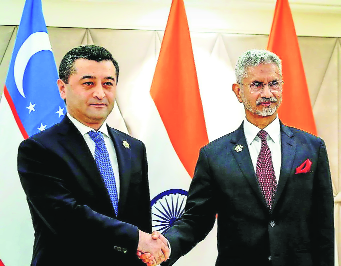
INDIA and Uzbekistan discussed key issues on their bilateral agenda and stressed the need for timely implementation of agreements reached at the highest level during a meeting between External Affairs Minister S Jaishankar and his Uzbek counterpart Bakhtiyor Saidov in Azerbaijan’s Baku.
Jaishankar was in Azerbaijan on Friday for a day-long visit to review bilateral ties. He met President Ilham Aliyev and held talks with Foreign Minister Jeyhun Bayramov on trade, investment, energy, tourism and connectivity.
“Nice to see Uzbek @FM_Saidov at Baku,” Jaishankar said in a post on X. He also shared a photograph of him alongside the Foreign Minister but did not provide further details of the meeting.
Saidov arrived in Baku on Friday from Georgia after attending the first joint meeting of the foreign ministers of Georgia and five Central
Asian countries -- Kazakhstan, Kyrgyzstan, Tajikistan, Turkmenistan and Uzbekistan.
“Discussed key issues on the bilateral agenda and emphasised the importance of the timely and effective implementation of agreements reached at the highest level,” Saidov posted on X.
India-Uzbekistan ties have seen multiple high-level exchanges this year. Prime Minister Narendra Modi was conferred Uzbekistan’s highest honour for foreign leaders, the Oliy Darajali Do’stlik Order, during a visit to the country in August.
During Modi’s two-day visit, New Delhi and Tashkent upgraded their ties to a comprehensive strategic partnership and set a target of USD 5 billion in bilateral trade.
The two sides also signed 11 agreements to boost cooperation in key sectors, including mining and tourism, and agreed
to establish a framework for the long-term supply of uranium from Uzbekistan to India.
Earlier on Friday, Jaishankar also visited the historic Ateshgah fire temple near Baku. In a post on X, he described it as a “symbol of the historical and cultural connect between our two peoples”.
The pentagonal, castle-like complex was largely built and used in the 17th and 18th centuries by Hindu and Sikh merchants from the northwestern part of the Indian subcontinent. Its walls bear inscriptions in Sanskrit and Gurmukhi script, including some Hindu invocations and a Sikh verse.