IMD’s advanced Doppler Weather Radar to come up in Jabalpur after crucial nod
| Date :26-Oct-2026 |
By Dhanendra Chaurasia :
Jabalpur is set to take a major step forward in weather monitoring, with an advanced Doppler Weather Radar (DWR) planned at the India Meteorological Department (IMD) centre in Adhartal.
The Jabalpur Municipal Corporation has recently issued a No Objection Certificate (NOC) for the project. The Town and Country Planning (T&CP) department has also stated that its permission is not required for such a structure. Soil testing has been completed and the report has been sent to the IMD headquarters in New Delhi. These developments have brought the project closer to the installation stage.
The radar is being set up under the Central government’s ‘Mausam Mission’.
It will cover an area within a radius of 250 km and help track active weather systems, heavy rainfall, thunderstorms, cyclonic activity and sudden changes in weather. The system will benefit Jabalpur as well as several nearby districts.
The installation is significant because existing Doppler radars in Bhopal, Nagpur and Raipur do not adequately cover Jabalpur. The new system will help improve weather monitoring across a much wider area.
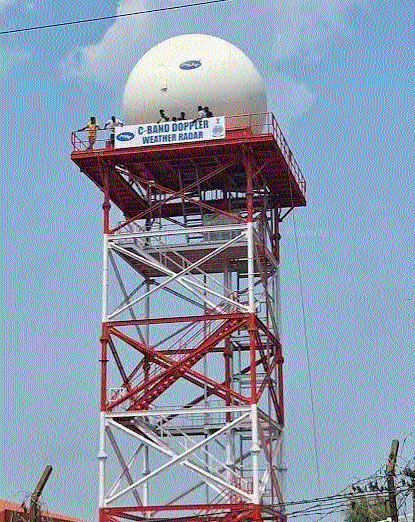
Senior officials at the IMD Jabalpur informed that as per the proposal, the DWR will be installed on an iron-pillar structure with a dome-shaped radar on top. Its proposed height is 27 metres, comprising a 20-metre structure and a seven-metre dome. The height may be increased by another five metres if required to prevent obstruction to the radar beam.
No concrete building is proposed.
The radar will use the Doppler effect to track weather conditions in the atmosphere. It
will provide real-time information on clouds, rainfall, wind speed and thunderstorms.
This will help improve weather forecasts, issue early warnings and strengthen disaster preparedness.
Officials further informed that Jabalpur and nearby areas often
experience heavy rainfall, thunderstorms and weather-related flooding. At present, the IMD uses radiosonde and radio-wave methods to collect weather data, including temperature readings, within a limited area of around 30 km. The new DWR system will improve monitoring over a much wider area. It will help farmers plan agricultural activities and enable government departments and residents to prepare better for severe weather. It will also support timely decisions during weather-related emergencies.