Pipeline works leave roads in tatters
| Date :03-Oct-2026 |
Staff Reporter :
Poor restoration after utility works continues to trouble commuters n Commuters on LAD Square-VNIT stretch bear the brunt
lack of coordination among agencies undertaking drinking water and sewage pipeline works has emerged as a major reason behind deteriorating condition of several roads in the city. Roads are dug up to lay pipelines and, after the work is completed, the affected portions are often restored through patchwork.
The issue is visible on roads where pipeline work has been carried out on a substantial portion of the carriageway. Once the dug up portion develops uneven surfaces and potholes, motorists tend to avoid it and shift to the better portion of the road.
This increases traffic load on the undamaged side, resulting in congestion and faster deterioration of the remaining surface.
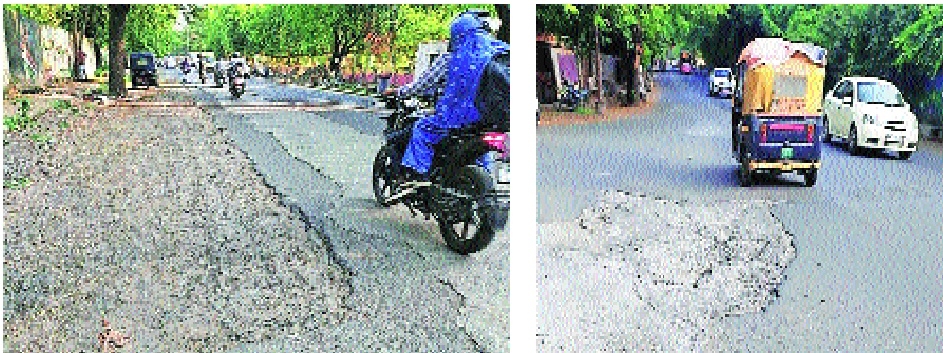
Road from LAD Square towards VNIT is one such example. Pipeline laying work was carried out on half of the road around three years ago. However, restoration undertaken after completion of the work was largely patchy.
Years after the pipeline was laid, commuters continue to face consequences of poor restoration. Difference between the original road surface and the portion affected by the pipeline work remains evident, raising questions over the quality of road reinstatement and supervision of the work.
Such instances indicate that damage caused by utility works does not end with completion of pipeline laying.
Poor restoration can leave a road in a compromised condition for years, forcing motorists to negotiate uneven surfaces while shifting traffic pressure to the unaffected portion.
This is the situation on several roads where different agencies undertake excavation independently. In absence of proper coordination, the same road may be dug up repeatedly for water supply, sewerage, electricity, telecom or other utility works. Citizens question why agencies cannot prepare a coordinated utility-work plan before taking up works. They have also demanded that contractors be made responsible for restoring entire affected portion properly instead of merely filling the trench and carrying out superficial patchwork. For the civic administration, the issue also has a financial dimension.
Roads repaired with public money are dug up for utility works, while inadequate restoration necessitates further expenditure on repairs. A coordinated approach can help avoid this cycle. Contractors should also be held accountable for quality and durability of restoration.