2nd consecutive win for Cong’s Abhijeet Wanjari
Suspense over winner of Nagpur Graduates’ poll ends in a nail-biting finish
Suspense over winner of Nagpur Graduates’ poll ends in a nail-biting finish
| Date :30-Oct-2026 |
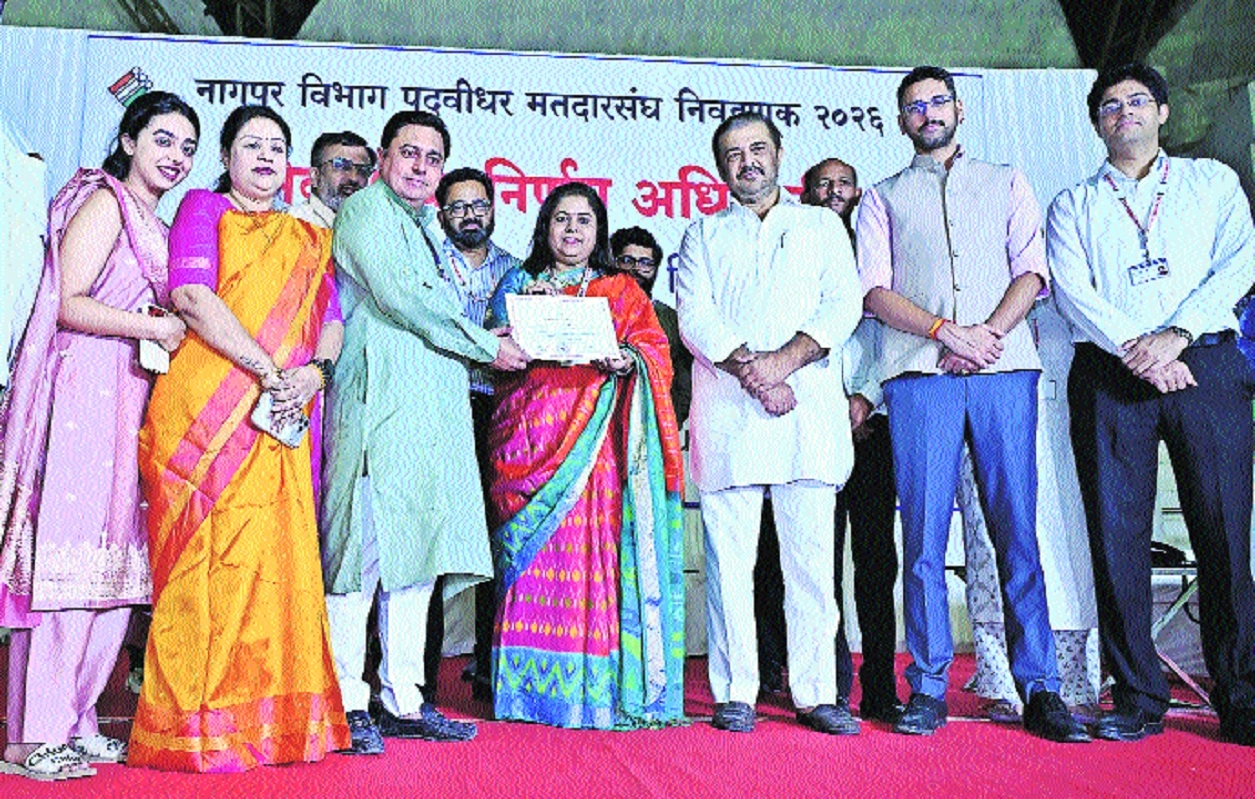
Adv Abhijeet Wanjari receiving winner’s certificate from Vijaylaxmi Bidari. Dr Smeeta Wanjari, Sunil Kedar, Dr Vipin Itankar, Kumar Ashirwad, Irshad Ali and others look on. (Pics by Satish Raut)
Staff Reporter :
Indian National Congress candidate Adv Abhijeet Wanjari won the Nagpur Division Graduates’ Constituency election to the Maharashtra Legislative Council, securing a total of 67,231 first and second preference votes. His nearest rival, BJP candidate Sudhakar Kohale, polled 63,960 votes. This is the second consecutive win of Adv Wanjari in the same constituency.
Divisional Commissioner and Returning Officer Vijaylaxmi Bidari handed over the winner’s certificate to Wanjari following completion of the counting process.
The counting began at 8 am on Tuesday, October 27, at the Divisional Sports Complex in Mankapur, Nagpur, with 84 tables deployed for the exercise.
The process continued for more than 41 hours before the final result was declared on Thursday.
Election Observer Dr Harshdeep Kamble, Returning Officer Vijaylaxmi Bidari, Assistant Returning Officers and Collectors from all districts in the division, and officers and staff deployed for the counting were present during the process.
Neither candidate secured the required quota of 75,438 votes in the two rounds of first-preference counting.
Consequently, the counting proceeded to the elimination round for second-preference votes, as prescribed under the election procedure.
Of the total 1,65,906 ballot papers counted in the two first-preference rounds, 15,032 were declared invalid, while 1,50,874 votes were found valid.
Even after second-preference elimination round, no candidate could reach the prescribed quota. Wanjari, who secured the highest total of 67,231 votes after combining the first and second-preference votes, was therefore declared elected.
The Election Commission of India had announced the schedule for the Nagpur Division Graduates’ Constituency election on September 22. The election notification was issued on September 29, and polling was held on October 23 from 8 am to 4 pm. Counting commenced at 8 am on October 27 and concluded after more than 41 hours.
The Commission has scheduled completion of the election process by October 31.
As none of the candidates secured the quota of 75,438 votes in the first two rounds of counting, the election authorities proceeded with the elimination round to distribute second-preference votes in accordance with the procedure. Of the total 1,65,906 votes counted, 1,50,874 were declared valid, while 15,032 were rejected as invalid. The high number of invalid votes has raised questions about the reasons for their rejection and the counting process. Even after the second-preference elimination round, no candidate could secure the required quota.
Consequently, Congress candidate Adv Abhijeet Wanjari was declared elected after securing a combined total of 67,231 votes across the first and second-preference counting rounds. BJP candidate Sudhakar Kohale secured 63,960 votes, trailing Wanjari by 3,271 votes.
‘Win reflects graduates’ trust, MVA unity’
Congress leader and MVA candidate Abhijeet Wanjari on Thursday said his victory in the Nagpur Division Graduate Constituency election was not his alone, but a reflection of the trust reposed in him by graduates and the unity of the Maha Vikas Aghadi (MVA).
In his reaction after the victory, Wanjari thanked voters who stood by the values of democracy and supported change. He also expressed gratitude to Congress workers and leaders and workers of all constituent parties of the MVA for their collective efforts.
Wanjari said that during the last six years, he had consistently raised the concerns of graduates in the Legislative Council and made sincere efforts to fight for their rights. He described the mandate as recognition of his work and a source of inspiration to discharge his responsibilities with greater commitment in the coming years. He said he would continue to fight for employment opportunities for unemployed graduates, justice for the concerns of youth, resolution of problems in the education sector, recruitment-related issues, restoration of the Old Pension Scheme and various demands of employees.
Wanjari said the victory represented not merely the success of an individual candidate, but also the aspirations of graduates and the power of the people in a democracy.
Wanjari thanked MVA leaders, office-bearers, party workers, teachers' and employees' organisations, and everyone who had supported his candidature directly or indirectly. He said he was committed to living up to the trust placed in him by the electorate.
From two defeats to two consecutive MLC wins
Adv Abhijeet Wanjari carries forward the legacy of his father, late Govindrao Wanjari, who represented South Nagpur in the Maharashtra Legislative Assembly. His electoral journey, however, began with setbacks. He first contested a municipal corporation election in 2002 but could not win.
Following his father’s demise in 2004, Wanjari expected to receive the Congress ticket from South Nagpur. When the party did not nominate him, he contested as an Independent candidate but faced defeat.
In 2014, he contested from East Nagpur but failed to win.
His position within the party continued to grow as he was entrusted with organisational responsibilities.
Wanjari also became active in Senate elections of RTMNU. He not only won the university elections but also established himself as an influential player in the formation of electoral alliances and the determination of outcomes. When Congress fielded him from the Nagpur Division Graduates’ Constituency in 2020, the BJP was considered to have an advantage. However, Wanjari’s experience in university politics helped him navigate the contest and secure victory. His latest win marks his second consecutive victory in the Legislative Council election, following two unsuccessful attempts to enter the Legislative Assembly.
The journey from defeats to MLC victories reflects a career shaped by organisational work, university politics and an understanding of mechanics of preferential voting.