India votes in favour of UNGA resolution calling for end to US embargo on Cuba
| Date :30-Oct-2026 |
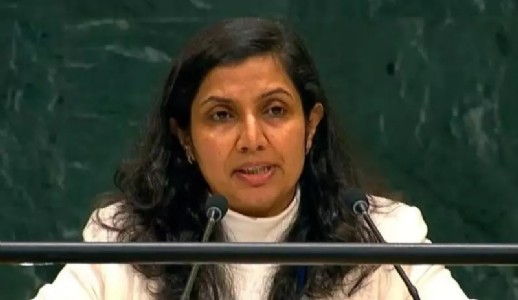
UNITED NATIONS :
INDIA voted in favour of a UN
General Assembly resolution
calling for an end to the economic, commercial and financial embargo imposed by the US
against Cuba, reiterating that the
restrictions should be lifted to
help the Caribbean nation pursue its development aspirations.
The 193-member General
Assembly adopted the resolution on Wednesday with 130
countries voting in favour, 17
against and 25 abstaining.
Delivering India’s statement,
Counsellor at India’s Permanent
Mission to the UN Soumya Nair
said the General Assembly has
repeatedly called for an end to
the embargo and rejected laws
and regulations with extraterritorial effects that adversely affect
the sovereignty of other states and
the progress and prosperity of
their peoples.
“India reiterates the Assembly’s
call to all states to refrain from
promulgating and applying, and
to repeal and invalidate, such
laws and measures in conformity with their obligations under
the Charter of the United Nations
and international law,” she said.
Nair said India’s commitment
to multilateralism is rooted in
the belief that international challenges are best addressed
through dialogue and diplomacy, in accordance with the UN
Charter. “It is in this spirit that
India hopes that the embargo
will be lifted at the earliest to
help create an environment
that would enable the people
of Cuba to participate more
fully in international cooperation and pursue their legitimate development aspirations,” she said.
Citing a report by the UN
Secretary-General, Nair highlighted the impact of the restrictions on Cuba’s economy and
essential services.
Cuba’s health system faces
shortages of over 60 per cent
of essential medicines, while
food production has declined
by more than 50 per cent in the
past five years, she said.
“The restrictions on fuel
exports to Cuba have also
aggravated the country’s ongoing energy crisis. The shortages
have disrupted essential services, including healthcare, education, water supplies, food
distribution, and transportation,” Nair said.
The conflict between
America and Cuba stems from
a decades-old political, economic, and ideological divide
that began when Fidel Castro
overthrew a US-backed
Government in 1959 and
aligned the island with the
Soviet Union. Washington has
maintained a strict trade
embargo and sanctions against
Cuba for over six decades to
pressure its communist regime.
Cuba blames these restrictions
for crippling its economy, causing severe fuel shortages, blackouts, and deep poverty.
The resolution, titled
“Necessity of ending the economic, commercial and financial embargo imposed by the
United States of America
against Cuba”, reflects the
General Assembly’s longstanding Opposition to the US
restrictions. However, General
Assembly resolutions of this
nature are not legally binding.