... AND THATS THE STORY OF OUR MORALS
| Date :07-Oct-2026 |
By Biraj Dixit :
Of all the definitions of morality, perhaps the nearest-to-reality (and practised most-often) is the one given by Oscar Wilde. Wilde says, ‘Morality is simply the attitude we adopt towards people whom we personally dislike.’ Profound...pungently!
In my naiveté, I presumed morals to be those simple discerning faculty within each of us that helps us tell good from bad. Too simple isn’t it? Nay, morals cover a lot of world ‘within’ and ‘without.’ As Wilde explains to us, they stem from something much more personal.
I felt so safe attributing the evils of the world to loosening moral codes of humanity but things, these days, aren’t adding up. Mow down a person because he has not responded well to your enormous honking, molest a girl because she is ‘chalu’ enough to be with a guy, sanction a country because it refuses to take sides in wars of other countries! It is ‘Dislike’ and not the ‘greater good’ that rules our unruly ‘holiness.’
Just like that
While it breaks faith into pieces in the ultimate goodness of the human race, it explains a lot of our ‘moral clarity’. I always wondered why women were hidden off into ‘purdah’ and ‘ghoonghat’ within the four walls of the household for protection when all ages have produced enough women of steel and substance! It may not always have been the high moral ground of offering protection. Rather in the dislike for strength in the presumed-not-so-strong.
Once Karl Marx had explained the division of the world into haves and have-nots, it was presumptuously presumed that the haves will share things a little bit with the have-nots and they will live happily ever after. The assumption did not take into account the high moral code of ‘dislike’. The dream of classless society has many classes now thanks to the human capacity to ‘dislike.’
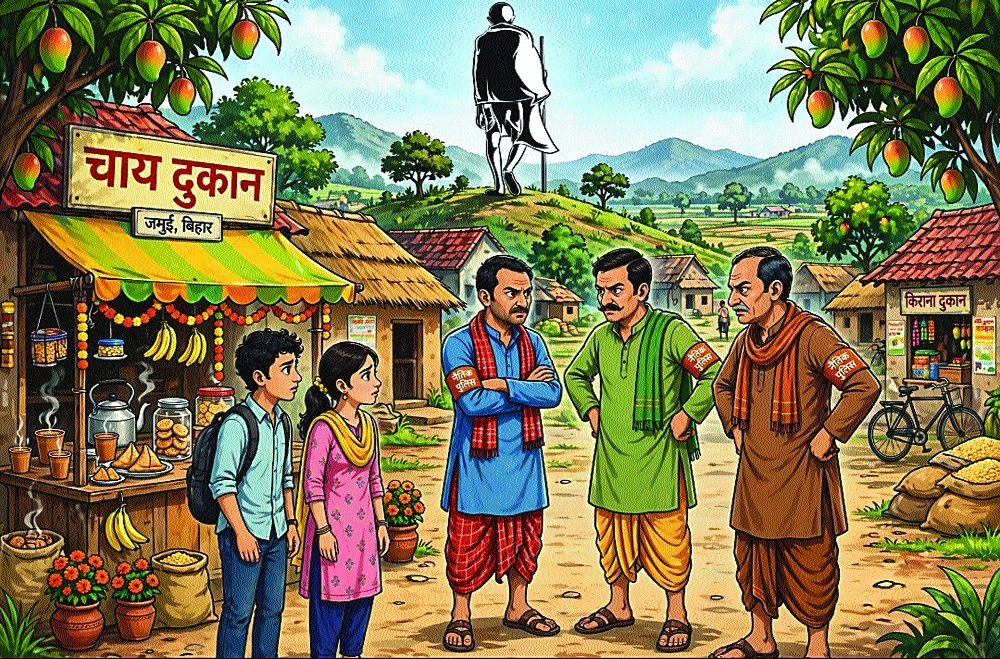
The incident in Jamui also was an outcome of high moral ground of ‘dislike’.
A girl and a boy heading home late evening must have done something distasteful and so must be taught a lesson. The utter dislike for immoral things led those 6-7 men to descend from their high moral pedestal and grope and assault a minor girl.
Even at the international-levels too, ‘dislike’ makes more rules than principles of justice ever could. The United Nations was reminded of its objectives, one of which was to be objective. “How,” asks the world body, showing its tied hands and the powerful nations’ ‘dislike’ for its true independence.
This very powerful element of ‘dislike’ comes in its full display every October 2, when this nation of 1.4 billion people, partly celebrates the birth anniversary of Father of the Nation. Partly because many find it hard to join the celebrations given their utter ‘dislike’ for the man, known for his high moral character.
They question whether he was truly a Mahatma and go on to point out how he was not the saint he is attributed to be. The others have now come in defence explaining why he should be the most ‘liked’ man.
“Go on, like me, dislike me,” the Mahatma says, “but careful with the language dears. Trust me, even while fighting with the British we had not once used the language you do.
Dislike, like high moral grounds, should have its boundaries,” the father reminds a nation that now has a new-found dislike for old-school morality.
So, for those old-schoolers who still presume that a person’s morality includes things like not lying, not cheating, not disrespecting others, not stealing, not compromising on means to justify end… well, well, well, too bookish an explanation my friends!
The morality, in practice, says, ‘awful if you do it, reasonable if I do it.’ ‘if I hate the colour red, it surely belongs to evil,’ ‘if a man is a genius, he earns my dislike for I know I am a mediocre,’ ‘the smartest girl is the sluttiest because she has earned my dislike,’ ‘personal integrity, very often, ruins the flavour of personal success. The former is no match for the later and can be sacrificed easily,’ ‘friends need yes-men. Honesty may not be an attribute,’ ‘Lying is an art, hone up your skills.’
The world presently is facing severe environmental challenges but since the word ‘environment’ has earned a formidable ‘dislike’ among the moghuls of high morality, it is but a storm in a tea-cup.
There is a tussle going on in the AI world too. One section says it is too dangerous, the other says it is too profitable. Guess whose morality will win? You guessed it right - the winner will be the one who dislikes the most.
n