Rajnath launches Fleet Support Ship-1, ‘Surya’ at HSL in Vizag
| Date :07-Oct-2026 |
VISAKHAPATNAM :
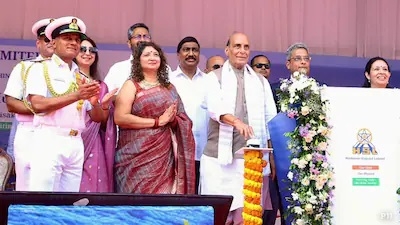
DEFENCE Minister Rajnath Singh on Tuesday launched the Fleet Support Ship-1 (FSS-1) here, calling it a symbol of achievement and an important step towards strengthening the Navy’s operational reach and endurance.
Singh launched the first fleet support ship, laid the keel of the fifth fleet support ship and inaugurated the upgraded Slipway-4 and a 300-tonne Goliath Crane at Hindustan Shipyard Limited (HSL) here.
Christened as ‘Surya’, FSS-1 entered the waters of the Bay of Bengal amid cheers.
“The launch of FSS-1 is a symbol of achievement, keel laying of FSS-5 a symbol of resolve and the new Slipway is a symbol of our growing capability,” said Singh, addressing a meeting in the port city.
He noted that a Navy operating for extended periods in distant maritime areas requires not only warships but also logistics, maintenance, sustained support and operational endurance.
Fleet Support Ships provide this essential capability through at-sea replenishment and sustained support to naval operations, he added.
Singh underscored the launch of FSS-1 as an important step towards strengthening the Navy’s operational reach and endurance, while the keel laying of FSS-5 representing another strong foundation for India’s maritime future.
Emphasising on the FSS programme, Singh said the vessels would strengthen the Navy’s reach, endurance and operational effectiveness in the Indian Ocean Region.
“Designed and built indigenously by HSL, the Fleet Support Ships will feature enhanced cargo and fluid capacity, onboard first-line maintenance workshops, a helicopter deck for multi-role helicopter operations and self-defence systems,” an official release said.
Singh said HSL was strengthening not only its shipbuilding capacity but also the foundation of India’s maritime power and described it as a custodian of India’s national maritime capability.
He lauded its contribution to the country’s maritime and defence requirements for more than eight decades.
As part of enhanced infrastructure to support larger shipbuilding programmes, the upgraded Slipway-4 has been extended and strengthened to enable HSL to build and launch ships of up to 45,000 DWT (deadweight tonnage--the maximum weight a ship can safely carry).
This is a prominent expansion of the shipyard’s capacity to undertake large and complex platforms.
The 300-tonne Goliath Crane spanning Slipways 3 and 4 has been designed and manufactured by L&T Geostructure with Konecranes under “Make in India”.
Equipped with PLC controls, variable frequency drives, tandem lifting, remote diagnostics and condition monitoring, the crane will enable faster and more precise handling of heavier blocks for modern block construction, the press release said.
The new infrastructure will strengthen HSL’s ability to undertake larger and more complex shipbuilding programmes and support modern block construction.
Calling on Andhra Pradesh to play a larger role in India’s maritime future, the defence minister noted that self-reliance is an important milestone, but global competitiveness is the next big leap.
Singh stressed that Indian shipyards should be able to compete on quality, cost, technology, delivery and reliability with the world’s leading shipyards.
He called on HSL to become more closely integrated with Andhra Pradesh’s wider industrial ecosystem.
Singh said the southern state’s MSMEs could become suppliers, universities could contribute to research and skill development, technology companies could support digital shipbuilding and startups could develop maritime technologies.
The objective should be to develop a complete shipbuilding ecosystem around HSL, supported by logistics, port infrastructure, research, technology and skilled manpower, he said.
Delving on Visakhapatnam’s strategic importance, Singh said the presence of the Eastern Naval Command, Naval Dockyard, HSL and Visakhapatnam Port provides the city with the foundation of an integrated maritime ecosystem.
He called for Visakhapatnam to be developed as a major maritime industrial hub by bringing together naval expertise, shipbuilding capability, engineering talent, port infrastructure and skilled manpower.
Singh stressed the need for an integrated national maritime ecosystem involving the Navy, HSL, DRDO, academia, industry, MSMEs and startups.
“Our goal should be simple and clear- design better, build faster, deliver on time; operate efficiently and do maintenance effectively,” he added.
Singh highlighted that India’s defence manufacturing ecosystem had undergone significant transformation over the past decade with increasing focus on domestic design and manufacture of sophisticated systems and platforms.
Timely delivery, productivity, indigenous design capability, supply chain resilience, skilled manpower, capacity and cost competitiveness are the key areas that would determine India’s ability to convert its shipbuilding potential into global competitiveness.
Outlining priorities for HSL, Singh called for timely delivery to become an organisational culture, greater learning from leading global shipyards, stronger indigenous design capability, partnerships with MSMEs and startups, and development of lifecycle capability.
He also emphasised the importance of closer coordination between the Navy and shipyards.
Further, Singh said India’s objective should go beyond self-reliance to global competitiveness.
Indian shipyards should aspire to serve friendly nations and international markets and develop a global presence in maritime technology, ship repair and maintenance services and engineering expertise, he said.