Nana Patekar’s journey from acting to transforming India’s rural lives
Date :09-Oct-2026
MUMBAI :
VISHWANATH “Nana” Patekar, one of Indian cinema’s most formidable actors, a titan of acting and a dedicated social reformer, who passed away on Thursday at the age of 75, was revered for his intensely grounded performances, raw emotional authority, and commanding screen presence. He leaves behind a legacy that extends far beyond cinema.
For millions in rural India -- particularly across the drought-stricken belts of Maharashtra -- he will be remembered as a life-affirming force who dedicated his personal resources and later years to water conservation and agrarian relief.
While Patekar achieved immense professional success in cinema, his defining calling in his later years was his work in Maharashtra’s rural heartlands.
Deeply moved by recurring agrarian crises and severe drought in Maharashtra’s Marathwada and Vidarbha regions, he shifted his focus to grassroots social intervention.
He used to claim that his work in the transformation of rural and mofussil areas, especially in the water sector, was his attempt to give back to society. Staying connected with diverse groups and helping them was his
passion.
In September 2015, alongside fellow Marathi actor Makarand Anaspure, Patekar co-founded an NGO in response to widespread drought conditions and high rates of farmer suicides. Rather than engaging in symbolic philanthropy, Patekar personally visited affected families, seed-funded initial operations using his own savings, and rallied public support across urban and rural centres.
Understanding that sustainable relief required structural water availability rather than temporary hand-outs, his NGO focused heavily on watershed management and water security.
The foundation deployed earth-moving equipment to desilt hundreds of km of silted rivers, canals, streams, and lakes.
The rejuvenation of the Riddhi Siddhi River in Beed and campaigns on the Pus River restored dried-up riverbeds, successfully recharging local ground aquifers and reviving nearby wells and borewells. He facilitated the construction of farm ponds and check-nala-bunds (CNBs), securing billions of litres of water storage capacity and reducing dependence on emergency water tankers across hundreds of villages.
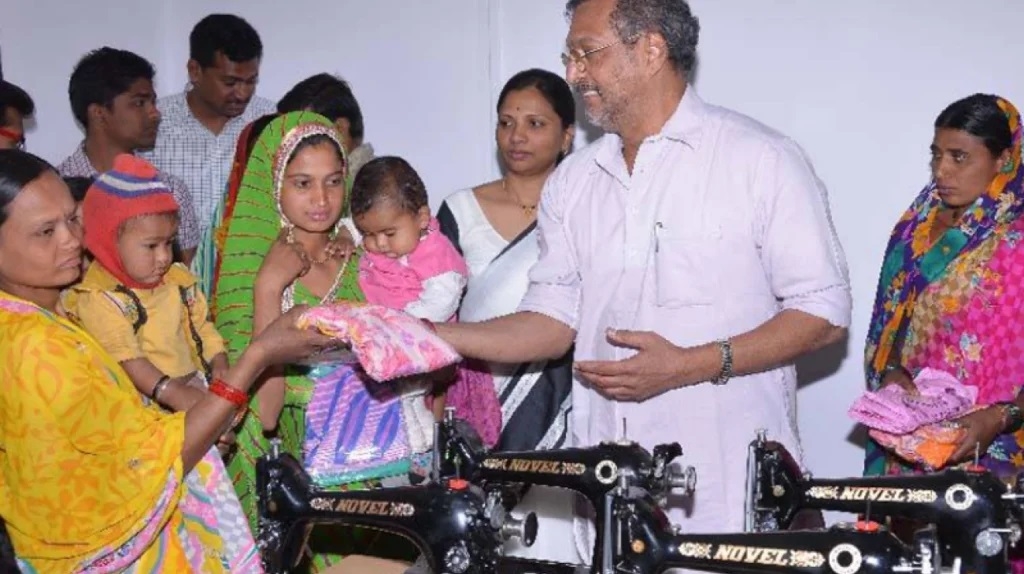
His NGO provided direct financial relief, vocational equipment (such as sewing machines and flour mills), and livestock to widows and dependents of farmers who had died by suicide, enabling long-term economic independence. The foundation adopted several severely affected villages to transform them into self-sustained ecosystems with access to clean water, group farming models, proper sanitation, and community spaces.
Nana Patekar represented a rare bridge between the heights of cinematic artistry and direct, hands-on social reform. His legacy is etched not only in the archives of Indian cinema but also in recharged rivers, lush agricultural fields, and self-reliant rural communities across India.
How Nana’s gift of sewing machine helped village woman rebuild life
BEED,
FOR Rajashree Asaram Pardeshi from Maharashtra’s Beed district, her livelihood and memories of veteran actor Nana Patekar remain bound by a single thread. When a crisis threatened her family’s future, a sewing machine provided by the actor’s foundation gave her the means to rebuild life with dignity.
“Around 10 years ago, the Naam Foundation gave me a sewing machine. My husband, a construction worker, had suffered a debilitating fall at a worksite and became bed-ridden. The responsibility of running our entire household fell on my shoulders,” said Pardeshi, a resident of Arvi village in Shirur Kasar tehsil of Beed.
Speaking to PTI after Patekar’s sudden demise, Pardeshi struggled to hold back her tears.
“By hemming sarees and stitching blouses, I earn around Rs 400 to Rs 500 a day, nearly Rs 10,000 a month. All of this became possible because of Nana Patekar,” she said.
“Touching the machine this morning made my heart race.
The man who brought Lakshmi into our home, our guardian angel, is no longer with us,” she added.
Pardeshi’s grief is shared by thousands of families across the Marathwada hinterland. For many rural women in drought-hit Beed, the passing of Patekar is being mourned as the loss of an elder who helped restore dignity and self-reliance to their lives.
The bond between Patekar and Beed was forged in 2015, when consecutive years of severe drought triggered a devastating rise in farmer suicides across the district. Village after village was engulfed in grief as agrarian distress reached critical levels.
Confronted with the humanitarian crisis, Patekar and actor Anaspure stepped in to support families of farmers who had died by suicide.
Their intervention went beyond immediate relief. The duo sought to create sustainable livelihoods for affected families by providing women with sewing machines, flour mills and livestock to help them establish small income-generating enterprises.
The Naam Foundation was subsequently established with a broader focus on long-term rural development, including livelihood generation and watershed management.
The timing of Patekar’s death has deepened the sense of loss in Beed, which is once again battling a severe drought. Riverbeds have run dry and villagers are struggling to find water for their livestock. Many who once looked towards the Naam Foundation for support during times of crisis now feel a painful vacuum.
Naam Foundation’s district co-ordinator Shivram Ghodake said the organisation had also undertaken extensive water conservation work in Beed to address chronic water scarcity.
In the Pimpalner belt of Beed tehsil, the foundation undertook desilting and widening work along a 34-km stretch of the Riddhi Siddhi river.
Following the intervention, the State Government constructed four small check dams along the river, benefiting residents of 14 surrounding villages and helping farmers grow crops across multiple seasons.
Across the district, the foundation deployed earthmovers to clear silt from nullahs, streams and reservoirs as part of its water conservation efforts.
“Because of the river deepening and water conservation work undertaken by the Naam Foundation in the district, nearly 10,000 hectares of land has come under irrigation, benefiting around one lakh farmers,” Ghodake said.