CR to test new cable that carries data and supports power needs for trains
Date :01-Nov-2026
By Sagar Mohod
Central Railway first over Indian Railway
to use OPGW to combine data plus power transmission
Central Railway has been chosen to pilot a novel two-in-one concept involving fusion of optical fibre cable (OFC) plus ground wire to be pulled through overhead equipment (OHE) poles on its network that is set to revolutionise the way data is transmitted and meet additional power.
The twin approach would secure the OFC from any damage, as it is crucial to railway operations, at the same time meet the requirement of power for additional locomotives to haul higher freight loads plus future needs.
For the same, the Railways have zeroed on optical fibre ground wire (OFGW) that has evolved through technological evolution and the nation's lifeline is betting high on its rollout as same would go long way in solving many issues.
This is first of its kind project over Indian Railways and its advantage is that for first time OFC is going to laid overground. Traditionally it used to put underneath the surface, by side of tracks under the ground through digging of trenches.
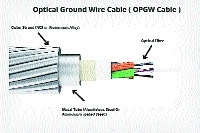
Explaining the feature of OFGW, Mohan Choudhary, Senior Divisional Electrical Engineer, TRD, Central Railway, Nagpur Division, said, this cable is equipped with two components. The outer core is made of pure aluminium that would transmit power to the OHE while the inner layer consists of OFC that would take care of data needs.
With the traditional OFC, often railways faced issues relating to its breakdown as it needed to be taken out often in case track expansion work was taken up. Similarly, it was prone to damage during any maintenance works and ultimately it affected train operations.
So OFGW being put up
through aerial route, the issue of damage or breakage due to manual intervention is more or less eliminated, said Choudhary.
As Railways is busy with adding additional 25 KV transmission along its route, an additional ground wire was needed for earthling and power needs. The 2x25 KV project that is progressing throughout the Indian Railways would feed the extra power to the OHE. Choudhary said as Railway services are expanding fast, new lines are being commissioned that means more number of trains are going to be on track at a time. In such situation the current power output needs to be doubled. So the OFGW would provide the additional power output enabling faster movement of trains.
He said this is a pilot project being conducted over CR's network and once successful it could be rolled out throughout the network of Indian Railways. Another advantage with OPGW is that it protects electrical conductors from lightning and fault currents, while enclosing optical fibers inside a central protective tube for high-speed telecommunications. The outer core of OPGW acts as a traditional static or earth wire to ground lightning strikes safely away from power phases. The single-mode or multi-mode optical fibers would be able to handle utility control, SCADA networks, smart grid data, and telecom leasing, added Choudhary. These cables are highly durable they are built to withstand harsh weather, ice loads, and high winds for a typical life span of 25 to 30 years.
Cost Efficiency: As it combines power and data needs into a single installation phase managed by utility companies, the cost efficiency is immensely crucial.