Lapping It Up!
| Date :19-Nov-2026 |
By Rahul Dixit :
Discussing someone’s private lives is still considered an
invasion into their
personal lives. More so, it is definitely not a topic to be shared from a public
platform. What struck Rahul Gandhi as
normal can register to others as unusual or overly intimate for a public recounting. Such disclosures have mostly invited societal backlash which he
is now experiencing.

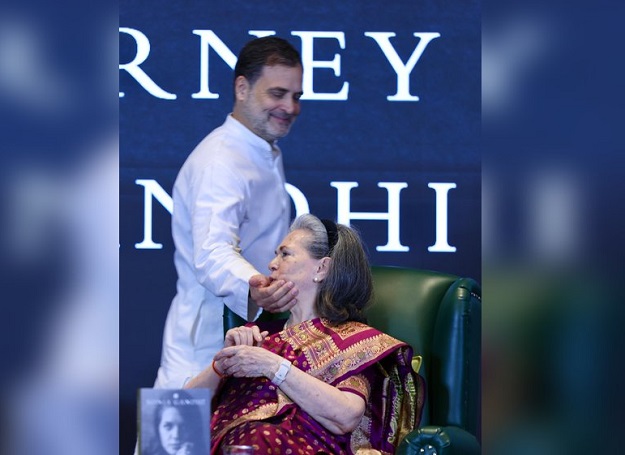
CALL it a Freudian Slip or an awkward folly but Congress leader Rahul Gandhi’s remark about his parents’ unusually demonstrative affection has sparked a fresh debate over his political acumen and cultural sensitivities. Though it was a childhood anecdote shared during his mother, Sonia Gandhi’s, memoir launch, it was clearly an oversharing of personal details which embarrassed the entire family and sent party leaders scurrying for a narrative to cover it. That it became a political controversy after the remark went viral on social media was also in line with the current polarised environment where vitriol and creativity regularly share equal digital space.
The core of Rahul Gandhi’s remark was the close bond his parents – late former Prime Minister Rajiv Gandhi and Sonia Gandhi – shared at home. It was purely a personal memory for Rahul Gandhi to see his mother “sitting on his papa’s lap at every meal”. It held no political connotation nor was it anyone’s criticism but it was excessive disclosure of intimate information which simply did not need to be shared in public.
The Congress leader’s attempt to normalise it by expressing surprise at mothers not sitting on their husband’s lap at his friends’ houses further led to a notion about entitlement during his childhood days and the other side of social boundaries. In a country, where private lives remain mostly confined within the four walls, Rahul Gandhi’s remarks came as a cultural shock for many.
Things were bound to take a political colour after the remark and Rahul Gandhi fanned the controversy further by coming up with reference to Goddess Parvati sitting in God Shiv’s lap in an ancient sculpture. It was a lame attempt at justifying his remark as a battery of Congress leaders and workers had already damaged the issue with their own takes on the “lap” remark. The question here is not about the political controversy over the remark, it is about the line to be drawn by people under constant societal glare on subjects to be discussed in public. On this count, Rahul Gandhi did step over the line and now must take the right lessons from the gaffe.
All over the world, political families, top industry honchos, film-stars and other celebrities live under constant public scrutiny. British tabloids have raked in moolah by snooping on personal lives of celebrities and Royals in the United Kingdom. Same parameters apply to people of high stature in India.
The Gandhi family is particularly under the lens of the media and people for its long political history. Considering this reality, sharing details that are usually part of private conversations should have been strictly avoided. Though it was a childhood memory for Rahul Gandhi, it was definitely not for public consumption considering the sensitivities attached with someone’s personal moments.
Leaders often use personal stories as political currency in their speeches. Many backroom stories have turned into excellent anecdotes in India’s political history. Mostly, these personal details, shared as a special memory, are related to political figures or private conversations on strategies or important subjects. Many such details, sometimes deliberately made public at an opportune moment, have turned into political controversies. Some use it as a calibrated strategy for political mileage while some share personal details (mostly unverified) as a tool to embarrass political rivals. However, in Rahul Gandhi’s case, the remark about his parents’ intimate moments neither had political substance nor was it a necessary revelation.
Physical affection between spouses has remained a beautiful part for private consumption in traditional Indian households. Show of affection, especially in the presence of children or household staff, has historically been less open in this part of the world. Some urban and elite or Western-influenced ones have gone beyond the traditional definition of affection but largely this show has remained in close confines and restricted to private conversations. Discussing someone’s private lives is still considered an invasion into their personal lives. More so, it is definitely not a topic to be shared from a public platform. What struck Rahul Gandhi as normal can register to others as unusual or overly intimate for a public recounting. Such disclosures have mostly invited societal backlash which Rahul Gandhi is now experiencing.
The remark was destined to draw political reactions.
The BJP treated it as odd and embarrassing with Assam Chief Minister Himanta Biswa Sarma suggesting that Rahul Gandhi had embarrassed his mother on a special occasion. Others described it as shamelessness disguised as simplicity. In one unguarded moment, Rahul Gandhi has provided ammunition to his detractors who have simply “lapped it up” with total glee. The jury is also out on social media, forcing the Leader of Opposition to play the Hindu card and his team to fight the self-ignited fire.
There are several political takeaways of this controversy for both Rahul Gandhi and the BJP. First, it is bound to damage his image among his own cadre. He is already seen as an elite coming from a privileged family. By showing no regard to societal sensitivity on relations between spouses, he has further endorsed the belief that he is unaware of the ground realities and cultural boundaries. Second, this image is set to be turned into a political weapon against Rahul Gandhi in the coming days, especially during elections in the culturally sensitive Hindi belt. Such notions effectively corrode a leader’s position among the electorate and on that count, Rahul Gandhi has scored a massive self-goal.