Money Without Morals
| Date :02-Nov-2026 |
By Rajyogi Brahma Kumar Nikunj Ji :
It is now almost universally recognised that the world economic situation, today, is very critical. The main causes of this crisis is because the present-day economic systems are divorced from ethics. Its a fact that none would deny. Such economic systems not only take into consideration the ethical values but also they generate unethical trends. The current world fiscal scene clearly shows that our economic thinking and our models of planning and development are out-of-touch with reality and are estranged from ethics.
Take, for example, the recent event of recession and also the event of fall in the exchange-rate of currencies of some of the developed countries. A little deep thinking as to the factors that led to these two events would lead us to the conclusion that these events occurred because some of the developed and affluent countries, had been spending much beyond their means. Households were handed easy credit, banks lent against assets that existed mostly on paper, and governments borrowed as though tomorrow's taxpayers would never ask for the bill. For a while the party looked like prosperity. When it stopped, ordinary people who had never signed a risky loan paid for it with their jobs and savings.
That is what happens when profit is the only question asked and nobody asks whether it is right.
It is known to all students of economics that when the International Monetary System was first constituted at Bretton Wood, the parity of national currencies of the member countries was determined according to the value of the US dollar. So, their parities depended on the stability in the value of the US dollar. But, ever since the US dollar began vacillating, the system of parities has been upset. Now, in the system, as it stands, the domestic policies of individual major industrial countries, especially the USA, highly influence policy of the developing countries. Thus the levers of power are now firmly in the hands of a few developed countries and they are often being used to the detriment of the developing countries, thus creating crisis in those countries due to huge losses in foreign exchange suffered by those countries due to change in Dollar rates.
Consider a small country that buys its oil and medicines in dollars. When the dollar climbs by even a few percent, its import bill swells overnight, though nothing in its own conduct has changed. It did not choose the risk, yet it is the one forced to cut spending on schools and hospitals to cope.
The variation in exchange rates, the high interest rates charged by the private international banks, the unequal distribution of monetary reserves, etc. are some other phenomena that point to the inadequacies and discrepancies of the present international monetary system. Further, we all know that there are presently two major economic systems at work- the Capitalist and the Communist. The former is based on competition, drive for profits and the law of value of the goods.
The thought of social good, the emotion of love for the human family and the consideration for the less fortunate brethren have little or no place in this system.
Moreover,the Capitalist system, by its very nature believes in expanding, exhausting natural resources and threatening ecological balances. Thus, it is bound to reinforce exploitative relationship between individuals and countries and to increase conflict. It has thus divided the world in two power blocs, tying up much of the funds to armament, thus impeding developmental work. So far as the communist form of economy is concerned, it is often alleged that it is intensely repressive, materialistic, indeed soul-less. Its discipline is ruthless and it constitutes totalitarianism. In brief, the result of the present economic world order is that about three-fourths of mankind lives in poverty.
This is not for want of resources. The world produces enough to feed and house its people; what it lacks is the will to share.
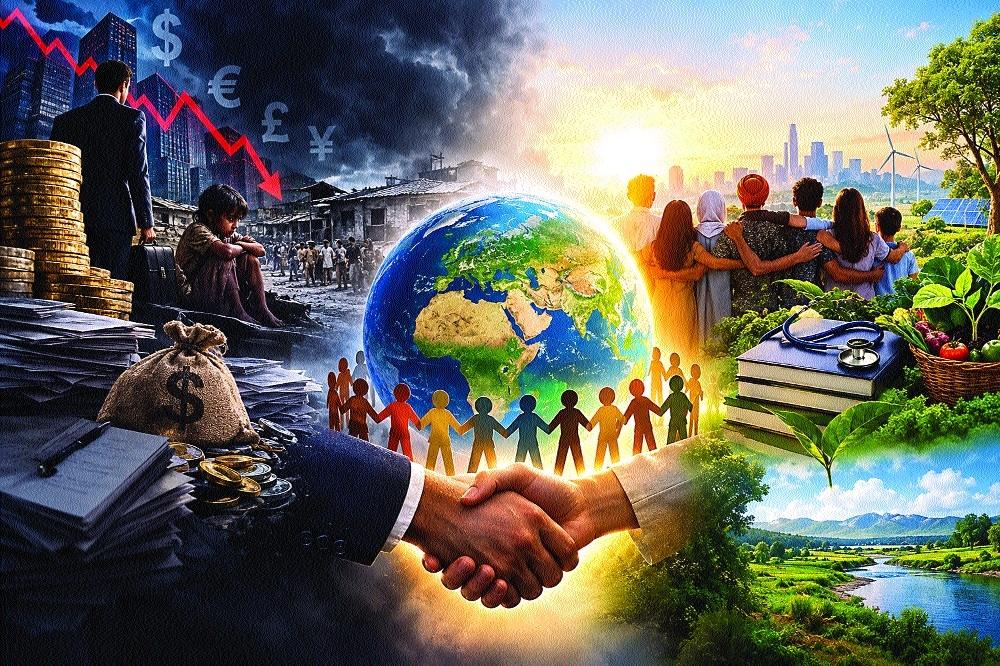
The remedy thus lies in basing the world economic system on love, humanism, and social consideration. Love and humanism may sound too soft for a subject as hard as money, but the idea is practical: lend fairly, trade fairly, and treat a neighbour's collapse as a warning for your own house. Debt terms that strangle poorer nations, a monetary order in which a few capitals decide for everyone, a defence budget that dwarfs spending on health: each is a choice, and choices can be remade. For this, there is the need that all countries commit for peaceful progress not only in their own lands but world-wide Global co-operation to restructure the international monetary system, basing it on human relationship which is the need of the hour.
n