The untold story of Madhya Pradesh
| Date :02-Nov-2026 |
Staff Reporter :
Seventy years after it was carved out on the map of India, Madhya Pradesh still reads like a novel - of stubborn princes, political chess moves and a capital chosen not by size, but by strategy.
Born on November 1, 1956 under the States Reorganisation Act, the new State stitched together Madhya Bharat, Vindhya Pradesh, Bhopal and the non-Marathi parts of Central Provinces and Berar. The merger was anything but smooth. In Bhopal, Nawab Hamidullah Khan’s initial resistance was overcome only after a popular merger movement and Sardar Vallabhbhai Patel’s firm intervention, leading to Bhopal’s accession on June 1, 1949. In Madhya Bharat, the rivalry was so intense that the Government famously functioned six months from Gwalior and six months from Indore.
Vindhya Pradesh saw such factional strife between Bundeli and Bagheli leaders that President’s Rule had to be imposed.
The fiercest battle, however, was for the capital. Jabalpur was geographically central and favoured in early recommendations, while Gwalior and Indore boasted palaces, administrative buildings and the prestige of being former Part-B capitals. Yet neither the Scindias of Gwalior nor the Holkars of Indore would accept the other’s city.
That deadlock opened the door for Bhopal - then a small tehsil of Sehore district and a Part-C State. Prime Minister Jawaharlal Nehru and Bhopal’s Chief Minister Dr Shankar Dayal Sharma backed it for its central location, direct rail link to Delhi, and as a symbol of national integration. Choosing Bhopal, Nehru believed, would
complete its Indianisation and strengthen communal harmony. The city of lakes was crowned capital of India’s then-largest State.
Boundaries were redrawn with equal pragmatism.
The Marathi-speaking districts went to Bombay State, making Madhya Pradesh a Hindi-speaking State, while Sironj tehsil was added from Rajasthan in exchange for Sunel Tappa. From Chambal’s ravines to Malwa’s poha-jalebi and Mahakaushal’s forests, the State earned its title - ‘Mini India’.
The vastness later became its weakness. With Bastar nearly 1,000 km from Bhopal, demands for a separate State grew, and on November 1, 2000, 16 districts were carved out to form Chhattisgarh.
Today, the State has 55 districts, 230 Assembly seats and 29 Lok Sabha seats, with newer districts like Niwari, Mauganj, Maihar and Pandhurna marking its growth.
Celebrations Continue
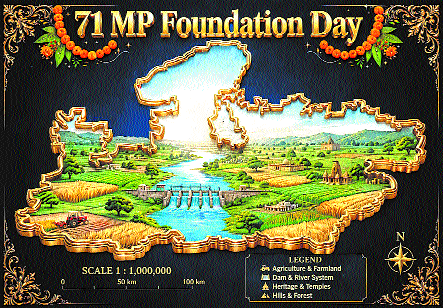
The 71st Foundation Day was marked on Sunday with a three-day Rajyotsav at Lal Parade Ground, Bhopal. Chief Minister Dr Mohan Yadav inaugurated the festival under the theme ‘Prosperous Farmer – Prosperous State’, unveiling a modern agriculture exhibition, development gallery and women’s entrepreneurship pavilion, followed by a grand cultural evening.