Move beyond rhetoric, restore depleting water bodies: Dr Rajendra Singh
| Date :21-Nov-2026 |
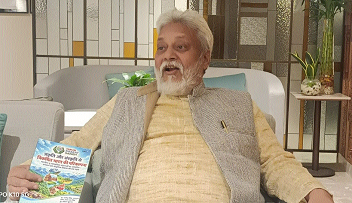
By Shivanjali Verma :
Renowned conservationist and recipient of Ramon Magsaysay Award (2001) and Stockholm Water Prize in 2015, Dr Rajendra Singh, widely known as the ‘Waterman of India’, emphasised on the urgent need for community-driven water conservation and cultural integrity during a recent visit to Jabalpur.
Dr Singh was in the city to attend the inaugural ceremony of a three-day birth centenary celebration of former Justice late Chandrashekhar Dharmadhikari at G S College on Friday.
Speaking in an exclusive interview with ‘The Hitavada’, Dr Singh urged citizens, youth, and policymakers to move beyond mere rhetoric and actively restore India’s depleting water bodies.
Reflecting on a journey spanning over five decades, Dr Singh recounted his earliest water management initiative in 1974 as an eleventh-grade student in Dhola village, Meerut. Mobilising classmates and persuading his grandfather to provide a tractor and diesel, the community independently resolved a chronic flooding issue without external financial aid.
Later, after resigning from his Government post as AY in 1985 and relocating to Alwar, Rajasthan, as an Ayurvedic practitioner, an elderly villager named Mangu Kaka redirected his focus from medicine to water scarcity. Under Mangu Kaka’s traditional guidance across 25 dry wells, Dr Singh gained foundational knowledge in geohydromorphology.
Working through Tarun Bharat Sangh, an organisation established in 1975 under his presidentship, Singh mobilised villagers to revive ancient, decentralised rainwater harvesting systems rather than relying on large scale Government engineering.
He gave Johad Model and River Rejuvenation formula to help villages to get rid of water crisis.
Since then, his collective efforts with rural communities have resulted in the construction of 15,800 check dams, rejuvenating 23 perennial rivers and reversing distress migration across 10,800 square kilometers.
Addressing the ecological State of Jabalpur, Dr Singh drew a sharp contrast between the historical water harvesting systems established 500 years ago by Rani Durgavati and the city’s present-day summer water crises.
He lamented the widening gap between reverence and action regarding the Narmada River, noting that society worships the river as a mother while simultaneously polluting and commercialising her resources. Criticising superficial public discourse, he remarked that sustainable change requires genuine public ownership rather than reliance on corrupt or inefficient bureaucratic frameworks.
On the intersection of economy and ecology,
Dr Singh defended his 1988 Supreme Court petition that led to the closure of 28,000 mines across Aravalli range, arguing that true national prosperity is rooted in self-reliant villages and sustainable
agriculture (kheti sanskriti). He highlighted that the 1.25 million workers displaced by mine closures were successfully rehabilitated and trained in water conservation work.
Dr Singh outlined his vision for cultivating water literacy (jal saksharta) among young citizens, stating that modern youth must understand India’s indigenous nature and culture to drive climate adaptation and local development rather than limiting their participation to protests.
Concluding the conversation, Dr Singh expressed his aspiration to publish localised editions of his book ‘Prakruti aur Sanskruti se Viksit Bharat ki Parikalpana’ for every State and village, inspiring children and youth to take active responsibility for restoring the ecological and spiritual richness of their neighborhoods and cities.