Orange City Literature Festival presents insightful conversations
India and China must learn to live together: R Gopalakrishnan
India and China must learn to live together: R Gopalakrishnan
| Date :22-Nov-2026 |
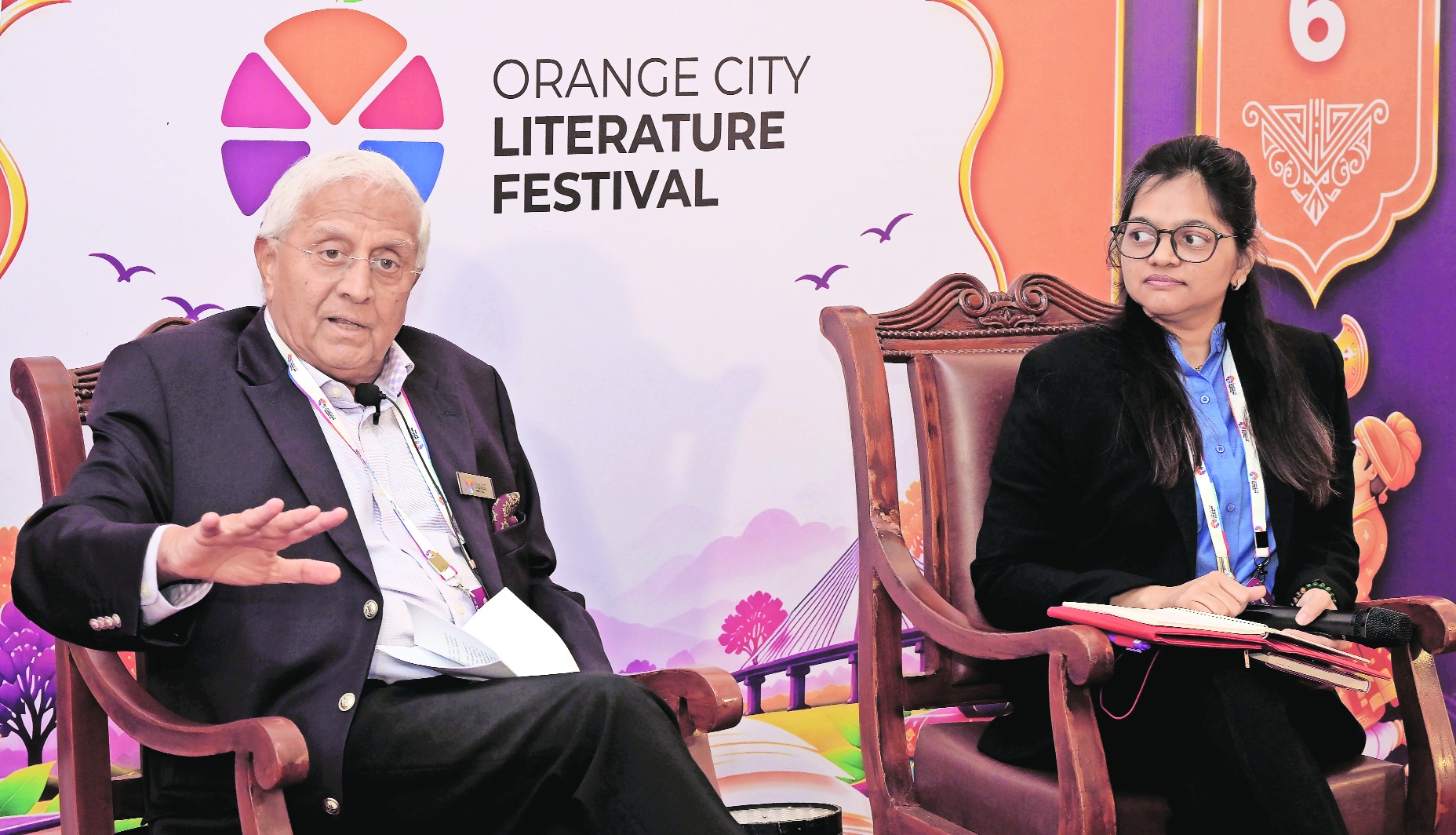
R Gopalakrishnan in an interactive session with Bhavya Chaudhary at the session held at Chitnavis Centre. (Pics by Anil Futane)
Staff Reporter :
R Gopalakrishnan calls for a mindset shift, stronger trade ties and investment in human capital
“No one is a permanent enemy; we have to learn to live together,” said R Gopalakrishnan, former Director of Tata Sons, while calling for India and China to move beyond historical grievances and build a more constructive relationship. He was speaking during a conversation with educator Bhavya Chaudhary on his book, ‘Chanakya and Sun Tzu: A Business Lens on Trade, Thought and Travel’, co-authored with Nirmala Isaac. The session was part of the Orange City Literature Festival, organised by Raisoni Foundation and was held at Chitnavis Centre, Civil Lines, on Saturday.
Drawing historical parallels, Gopalakrishnan referred to the Mauryan and Han dynasties, the Mughals and the Ming dynasty, and the Qing dynasty during British colonial rule in India.
He also spoke about ancient trade links between China and southern Indian kingdoms, including the Cholas, Cheras, Pandyas and Pallavas.
He said both countries had experienced colonialism, but differences sharpened after Independence. He urged them to look beyond the past and focus on present realities.
“Let’s forget the past and move forward,” he said, describing trade as an effective instrument for improving bilateral ties. India, he added, should work to reduce its trade deficit with China.
Responding to a question on public sentiment over China’s territorial claims, he compared the crowded societies of South and Southeast Asia to densely populated Mumbai neighbourhoods, where people learn to share limited space despite disagreements.
Gopalakrishnan said India must recognise the changing economic balance, noting that China’s economy is now several times larger. India should invest in human capital and skilled workers, as China had done, and become relevant before aspiring to superpower status.
He said both countries had the potential to become the world’s largest economies and that cooperation, rather than conflict, would be essential to achieving that potential.