BTR emerging as vital habitat for wild elephants in MP
| Date :26-Nov-2026 |
Staff Reporter :
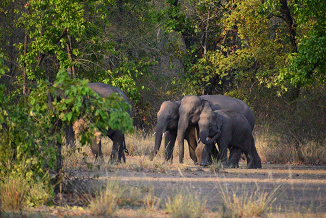
Bandhavgarh Tiger Reserve (BTR), widely known for its high density of tigers, is gradually emerging as an important habitat for wild elephants in Madhya Pradesh. The return of Asian elephants to this landscape after nearly a century has become a significant conservation success, although it has also brought new challenges involving human-elephant conflict.
What began in 2018 with the arrival of a herd of around 30-35 elephants from neighbouring Chhattisgarh has developed into a resident population. Today, approximately 50-70 wild elephants roam Bandhavgarh and adjoining areas, including Sanjay-Dubri Tiger Reserve and the Bansagar backwater region in Shahdol.
Historically, central India was an important elephant habitat, with forests stretching from Odisha and Bastar through Madhya Pradesh towards Gujarat. Historical accounts, including those of Mughal chronicler Abul Fazl, mention elephants in several central Indian regions. However, hunting, elephant capture, agricultural expansion and large-scale forest clearance gradually reduced their population. By around 1920, Madhya Pradesh had largely lost its resident wild elephant population.
Field Director of Bandhavgarh Tiger Reserve, Dr Anupam Sahay informed that the major comeback began in 2018 when a herd of wild elephants entered Bandhavgarh through the Shahdol corridor and Panpatha buffer range, moving through Patour and Khitauli towards Biruhli. Availability of water, diverse forests, grasslands and suitable habitat encouraged the elephants to settle. Khitauli tourism zone has particularly become popular among visitors for elephant sightings.
October 2024 tragedy prompted stronger
conservation measures
The growing population has also increased human-elephant
encounters, resulting in crop damage, destruction of houses and occasional injuries.
A major tragedy occurred on October 29, 2024, when four elephants from a herd of 13 were found dead near the Khitauli-Patour range boundary. Over the next two days, the death toll reached 10. Post-mortem examinations found large quantities of undigested kodo millet in their stomachs. Forensic investigations by laboratories in Jabalpur and the Indian Veterinary Research Institute, Bareilly, detected cyclopiazonic acid, a toxin produced by fungus-contaminated kodo. No pesticides were found, ruling out deliberate poisoning.
Following the incident, affected standing kodo crops were destroyed and the State Government announced a State-level Elephant Task Force.
Technology
strengthens
monitoring
The Forest Department has introduced GPS/VHF radio collars to monitor elephant movements. The first conflict-prone male was collared in November 2024 with technical assistance from the Wildlife Institute of India and WWF-India. Several other males have subsequently been collared.
The Department is also considering fitting collars to matriarchs, whose movements can help track entire herds.
Its ‘Gajrakshak’ mobile application shares elephant locations and sends alerts to villagers. More than 2,500 residents from over 125 villages have registered on the platform. A dedicated control room monitors elephant movements across seven affected districts of eastern Madhya Pradesh and sends daily updates to Bhopal.
Community
participation key to coexistence
The reserve has established ‘Hathi Mitra Dal’ teams comprising trained villagers and forest personnel. They alert residents about approaching elephants, discourage entry into affected forest areas and promote safe behaviour during encounters.
Madhya Pradesh has also joined the Centre’s Project Elephant framework. Research using radio-collar data is helping officials understand migration routes, habitat use and human-elephant conflict hotspots. However, timely compensation for crop losses, protection of forest corridors and coordination with neighbouring states remain essential.
The natural return of elephants to Bandhavgarh without a formal reintroduction programme is a remarkable conservation development. Its long-term success will depend on maintaining suitable habitats while ensuring the safety and livelihoods of communities living alongside these giant animals.