‘Higher edn must break barriers to women’s leadership’
| Date :26-Nov-2026 |
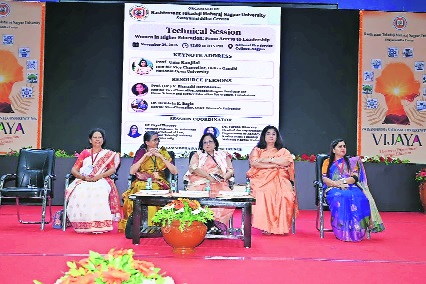
(From left) Dr Varsha Dhurvey, Dr V Bharathi Harishankar, Prof Uma Kanjilal, Dr Hemlata K Bagla and
Dr Payal Thaorey sharing the dais.
Staff Reporter :
Experts stress confidence, inclusive learning, flexible courses and livelihood opportunities at RTMNU’s Swayamsiddha conference
Higher education must go beyond providing women access to classrooms and create pathways to leadership, research, economic independence and decision-making, experts observed during a technical session on ‘Women in Higher Education: From Access to Leadership’ at the National Fire Service College, Police Line Takli, on Wednesday.
The session was part of ‘VIJAYA’, the two-day Swayamsiddha National Conference-2026 organised by Rashtrasant Tukadoji Maharaj Nagpur University (RTMNU) through its Swayamsiddha Centre.
Prof Uma Kanjilal, Vice-Chancellor, Indira Gandhi National Open University (IGNOU), delivered the keynote address, while Dr V Bharathi Harishankar, Vice-Chancellor, Avinashilingam Institute of Home Science and Higher Education for Women, Coimbatore, and Dr Hemlata K Bagla, Vice-Chancellor, SNDT Women’s University, were resource persons.
Kanjilal said women had the ability to become self-reliant but needed confidence, flexible learning opportunities and sustained institutional support. Highlighting the role of open and distance education, she said it enabled women unable to access conventional colleges to pursue higher studies.
Universities must not restrict their responsibility to awarding degrees but also help students acquire livelihoods and employment-oriented skills. She called for demand-based courses, curriculum flexibility and digital literacy from the school level, in line with the National Education Policy 2020.
Harishankar urged women to recognise their leadership potential and overcome the invisible glass ceiling. She observed that women contributed to leadership but often hesitated to identify themselves as leaders.
Unlike development, empowerment came from within, she said, stressing confidence, self-belief and the importance of sharing experiences to create opportunities for others.
Bagla emphasised equal opportunities in research, employment and institutional decision-making. She highlighted inclusive access for visually challenged and other students with disabilities, saying accessibility must extend beyond ramps to classrooms, libraries and learning material. Citing Gargi and Maitreyi, she described questioning as an expression of intellectual independence and encouraged women to aspire to leadership positions.
The session was coordinated by Dr Payal Thaorey and Dr Varsha Dhurvey. Dr Thaorey proposed the vote of thanks.